Thursday, September 13, 2012

Bill Clark Jumps with the 504 PIR into Salerno September 13, 1943

Today is September 13, 2012 – the 69th anniversary of the 504 PIR jump into Salerno, Italy. In this post and the next, we’ll continue in our analysis of Bill’s June 13, 1945 letter and in the process discover his role during the 82nd Airborne’s jump into Salerno. While most of the specific details have been lost, some surprising deductions can be made about his participation in that historic event.

“So a few days later we went to Salerno which was a “hot spot”. On the way down to the ground it looked like the whole earth was on fire it was really an ammunition dump on fire. Most of us landed in a spot between our lines and German lines...” Source: William Clark, letter dated June 13, 1945

The Invasion in the Bay of Salerno and the lead up to the 82nd Airborne’s Salerno Jump

The American and British forces of Operation AVALANCHE - units of the US VI Corps and the British 10 Corps – landed on the beaches of Salerno Bay, Italy at 3:30 AM on September 9. The American forces under the command of General Mark Clark, consisted primarily of the 36th and 45th Infantry Divisions with the 36th spearheading the invasion in the southern American sector.

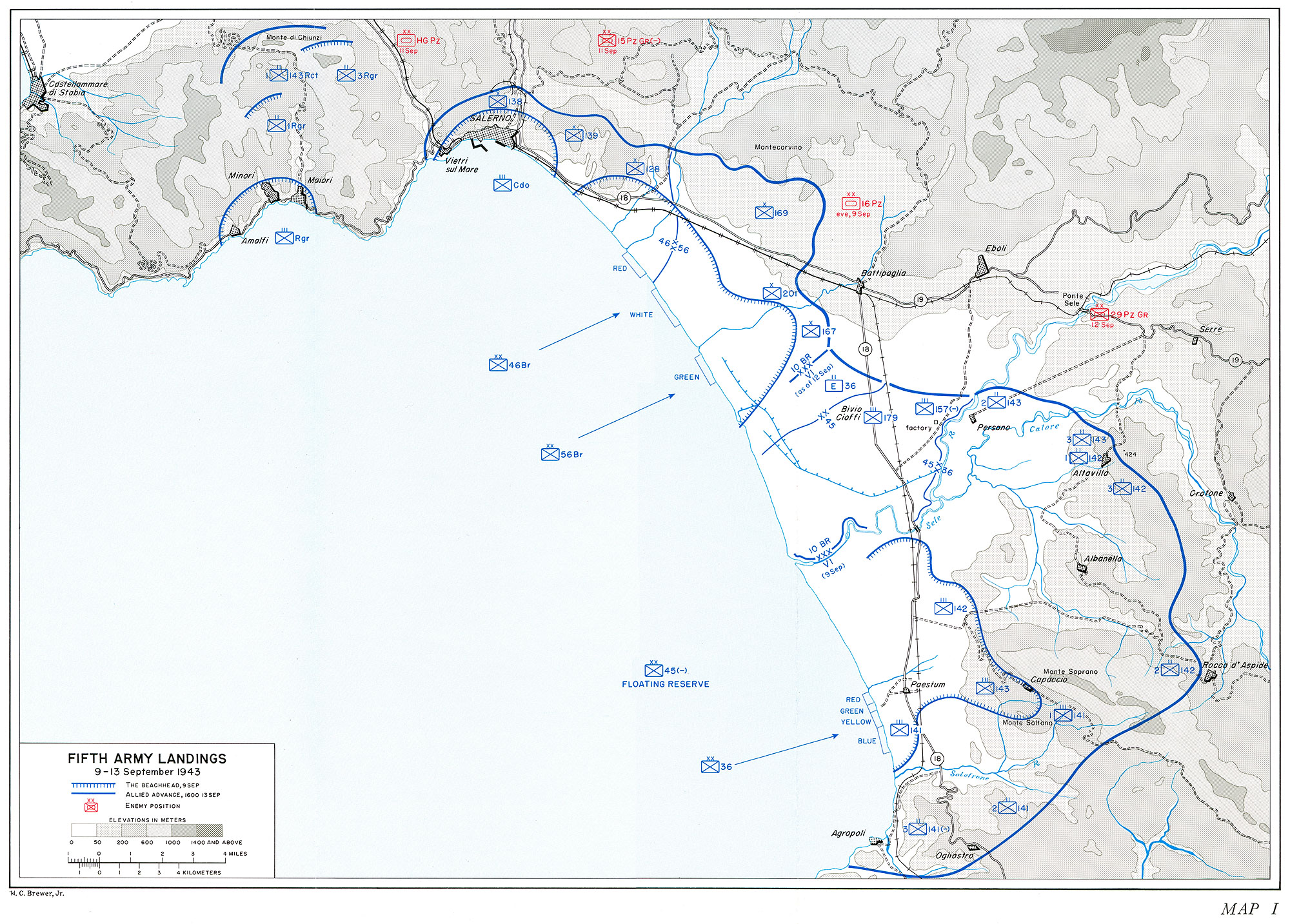
(Note:- the positions and movements of the British, American, and German units can be seen in Map 1 below. Click here for full resolution.)

Fifth Army Landing Beaches Salerno-I

Map 1: American VI Corps, British 10 Corps and German 1oth Army Movements/Positions 9 – 13 September, 1943

Source: “United States Army in World War II Mediterranean Theater of Operations: Salerno to Cassino”, Blumenson, M., 1993, p. 73 http://www.ibiblio.org/hyperwar/USA/USA-MTO-Salerno/USA-MTO-Salerno-6.html

(Click here to view Map 1 in high resolution )

“The British 10 Corps, with the 46th and 56th Divisions, three Ranger battalions, and two Commando units, was to land north of the Sele River, seize the port of Salerno, capture the Montecorvino airfield, take the little rail and road center of Battipaglia, secure the Sele River bridge fourteen miles inland at Ponte Sele, and gain possession of the mountain passes leading to Naples. The 7th Armoured Division was to follow, beginning to go ashore on the fifth and sixth day of the invasion.

The VI Corps, with the 36th Division, was to land south of the Sele River and protect the Fifth Army right flank by seizing the high ground dominating the Salerno plain from the east and the south--an arc of mountains marked by the villages of Altavilla, Albanella, Rocca d'Aspide, Ogliastro, and Agropoli. After the floating reserve--two regiments of the 45th Division--and the rest of the 45th had landed, the 1st Armored and 34th Infantry Divisions, and later the 3d Infantry Division, were to go ashore through the captured port of Naples, which the Allies hoped to have by the thirteenth day of the invasion”. Source: “United States Army in World War II Mediterranean Theater of Operations: Salerno to Cassino”, Blumenson, M., 1993, pp. 43 http://www.ibiblio.org/hyperwar/USA/USA-MTO-Salerno/USA-MTO-Salerno-4.html

“Anticipating that 39,000 German troops would be near Salerno on D-day and perhaps a total of 100,000 three days later, the [Allied] planners hoped to send about 125,000 Allied troops ashore. However, the Allied build-up to that figure would be progressive and relatively slow compared with the German capability of reinforcing the defenders.

In the [American] zone, the 36th Division, with infantry components 20 percent overstrength, was to land with two regiments abreast, the third in immediate reserve. Each assault regiment, including attachments, had the enormous strength of about 9,000 men, 1,350 vehicles, and 2,000 tons of supplies. Each was to carry in reserve about seven days of all classes of supply, plus a 20-percent safety factor. All vehicles were to be waterproofed, have their gas tanks and radiators full, and carry five quarts of oil and enough gasoline in cans for fifty miles of travel. All units were to carry basic loads of ammunition plus additional ammunition both combat and cargo loaded, which together would provide an estimated three days of fire. Ammunition to accompany the assault troops totaled 240 rounds per 60-mm. mortar, 300 rounds per 81-mm. mortar, 840 rounds per 105-mm. howitzer, 400 rounds per 155-mm. howitzer, and 300 rounds per 155-mm. gun. For the first three days of the landing operations all convoys were to be combat loaded, thereafter convoy loaded for more economical utilization of ship space” Source: “United States Army in World War II Mediterranean Theater of Operations: Salerno to Cassino”, Blumenson, M., 1993, pp. 49-50 http://www.ibiblio.org/hyperwar/USA/USA-MTO-Salerno/USA-MTO-Salerno-4.html

The Americans also had two regiments from the 45th Division floating in reserve bringing the total available manpower in their sector to 36,000. Their opposition was elements of the German 10th Army which occupied the Salerno area and was commanded by Colonel-General Heinrich von Vietinghoff, a savvy hardened veteran commander of the Russian Front. At the time of the invasion, the 10th only had one fighting unit active in the Salerno Bay area – the 16th Panzer Division.

VietinghoffHeinrich_thumb1_thumb

Colonel-General Heinrich von Vietinghoff. Commander of the German 10th Army in Italy in 1943

Source: Wikipedia commons

“Meeting the Americans, and the British as well, on the beaches of Salerno were troops of the reconstituted 16th Panzer Division, the only fully equipped armored division in southern Italy. Not quite at full strength, the division had 17,000 men, more than 100 tanks, and 36 assault guns organized into four infantry battalions, one equipped with half-tracks for better support of tank attacks, and three artillery battalions. Morale was good. Shortcomings were lack of combat experience, a shortage of gasoline, which restricted training of tank crews, and a long front of more than twenty miles.” Source: “United States Army in World War II Mediterranean Theater of Operations: Salerno to Cassino”, Blumenson, M., 1993, p. 78 http://www.ibiblio.org/hyperwar/USA/USA-MTO-Salerno/USA-MTO-Salerno-6.html

Even with the powerful 16th Panzer Division, and the advantage of occupying a highly defendable territory typified by rugged mountains and deep ravines, on the morning of September 9 the German’s were vastly outnumbered in comparison to the immense Allied invasion fleet. There were a variety of reasons for their predicament.

Two key divisions were denied movement south to Salerno because the German High Command expected other Allied invasions to come further up the coast above Salerno. Units escaping from the south in response to the British Operation Slapstick were expected to arrive in the Salerno area earlier than they did. When they did arrive confusion reined about whether they should stay or move on to Rome as was originally planned. In any case the units which were ordered to move to the Salerno area were understrength or in the process of reorganization from being pounded by losses sustained during the Sicily campaign. The Hermann Goring Division and the 15th Panzer Grenadier Division both being cases in point. On top of all this, fuel shortages hampered movement; and communications between General Vietinghoff, General Kesselring (the supreme German commander of Italy based in Rome), and Headquarters in Berlin were intermittent.

The poor communications in particular had a significant impact on General Vietinghoff’s decision making. Upon seeing the size of the Allied armada in the Bay of Salerno early on September 9, he was convinced it was the main Allied invasion. It was so large he surmised that the risk of other Allied invasions up the western Italian coast was low. Unable to contact General Kesselring for any advice on the matter he alone shouldered the decision to pull out and head for Rome, or stay to counterattack. His decision was to stay with the objective of defeating the Allies in what he correctly concluded was their main northern invasion force – the other being the British 8th Army moving up from the southern tip of the Italian peninsula.

The immediate forces at Vietinghoff’s disposal, while depleted, were still formidable. Together the Hermann Goering, 16th Panzer, and the 15th Panzer Grenadier Divisions totaled 45,000 men with some strong artillery forces and significant armored vehicles and Tiger tanks. Vietinghoff knew this might not be enough, so he was counting on the timely arrival of the German 29th Panzer Grenadier Division, scheduled to reach the Salerno vicinity on the evening of September 9. Lead elements of the 26th Panzer Division were anticipated to arrive the next day. Both divisions were evacuating from southern Italy, but unforeseen landings by another set of British forces in the south delayed their departure. They didn’t make it until September 10 and 11, respectively and then only in dribs and drabs of small unorganized groups. It wasn’t until the evening of September 13 that these units were sufficiently organized and of the large enough numbers that Vietinghoff began discussing using them to mount an effective counterattack against the beachheads being established by the Allies.

The combined manpower of the 26th and 29th Divisions was 30,000 – not to mention their tanks, armored vehicles and substantial artillery. The total expected base of manpower when added to the men already deployed in the area would have totaled 75,000. Had the southern German forces arrived in Salerno on time, the eventual outcome of the invasion could have been very different. Source: “United States Army in World War II Mediterranean Theater of Operations: Salerno to Cassino”, Blumenson, M., 1993, p. 67 http://www.ibiblio.org/hyperwar/USA/USA-MTO-Salerno/USA-MTO-Salerno-5.html

Vietinghoff’s decision to attack was made more risky when the bombing and artillery might of the combined Allied air and naval forces were considered. Both of which were far superior to that of the Germans. Fully aware of this, Vietinghoff believed that if he could gather all his available forces early enough he could overwhelm the Allies in a Blitzkrieg style attack, quickly destroying them before the navy and army air forces could respond.

After news of the invasion armada eventually reached General Kesselring in Rome, he and Vietinghoff asked for two Panzer Divisions to be sent south from their stations in Mantua, northern Italy to help repel the invasion. German High Command in Berlin denied the request. Had they actually been sent, it is almost a foregone conclusion that the outcome of the Salerno campaign would have meant annihilation for the Allies.

While waiting for the southern reinforcements, the 16th Panzer Division had earlier mined the invasion area and placed obstacles such as barbed wire. They also used psychological warfare methods (AKA PSYOPs) in the form of load speakers in the Paestum beach landing area declaring “Come on in and give up. We have you covered.” The men of the 36th Division ignored them, but there were other instances of PSYOPs used. For instance, the Germans played “Deep in the heart of Texas” when the Texas based 36th Division fought further inland.


USA-MTO-Salerno-p89

Troops of the 36th Division landing on the invasion beaches

Source: “United States Army in World War II Mediterranean Theater of Operations: Salerno to Cassino”, Blumenson, M., 1993 p. 89 http://www.ibiblio.org/hyperwar/USA/USA-MTO-Salerno/USA-MTO-Salerno-6.html

At 7:00 AM on September 9, the 16th Panzer Division attacked the Allied landing beaches in both the British and American zones with tanks and infantry, but were beaten back by the then untested, yet effective US 36th Infantry Division and the seasoned British 46th and 56th Divisions fighting to their left. Click on Map 1 above to see these details in high resolution.

If the Germans were experiencing problems organizing their retreating and depleted divisions into a worthy adversarial force, the Allies were having their own. Right from the beginning there was seven mile gap between the American positions to the south and the British forces invading on their left flank in the north. The gap opened because while moving toward their respective objectives, the British forces had gone to the northeast to engage the Germans in their sector while the US 36th Division had advanced east to do the same in theirs. Due to the slow build up on shore of the Allied forces there was insufficient men and machines to maintain a continuous front across both Allied sectors.

Over September 10 and 11 General Vietinghoff scrambled to assemble a force strong enough to slam the Allied invasion and annihilate it’s forces on the beaches before the survivors could escape by sea. Eventually he was able to cobble together an attack group consisting of units from the 26th Panzer Division and the 29th Panzer Grenadier Division retreating from the south. He used them to reinforce the 16th Panzer Division around the towns of Battipaglia and Eboli.

To the north in the British sector he used the Hermann Goring Division and the 15th Panzer Grenadier Division to attack the British who in the face of the onslaught were entirely committed to holding onto their own gains.

Meanwhile on September 10 the Allied forces were making good progress inland. The beachhead around the landing zones continued to be established inland positions expanded. Some nine miles west of Salerno, H Company of the 504th PIR and US Ranger units made a landing on the beaches around Maiori on the north side of the bay. Company H and seized the high ground around the Chiunzi Pass.

Plans were ready to be implemented for further gains in Salerno Bay area:

“The VI Corps plan for 11 September envisaged three separate but related attacks. On the left, the [45th Division’s] 157th Infantry was to cross the Sele River downstream from its junction with the Calore and attack north to Eboli. Seizure of Eboli, about eight miles from the Sele, would strike the German flank and rear and perhaps pry loose the German hold on Battipaglia; it would also facilitate 10 Corps' capture of the heights immediately overlooking the Montecorvino airfield. In the center, the [45th Division’s] 179th Infantry was to enter the Sele-Calore corridor near the juncture of the two rivers. Covering the right flank of the 157th, the 179th was to drive seven miles northeast across the flood plain to seize a bridge, Ponte Sele, and cut Highway 19, a good lateral route still open to the Germans. On the right of the low ground, a regiment of the 36th Division was to secure Hill 424 near Altavilla and deprive the Germans of a commanding view over much of the beachhead, as well as the flood plain, the valleys of the upper Sele and Calore Rivers, and portions of Highways 19 and 91”. Source: “United States Army in World War II Mediterranean Theater of Operations: Salerno to Cassino”, Blumenson, M., 1993 p. 104 http://www.ibiblio.org/hyperwar/USA/USA-MTO-Salerno/USA-MTO-Salerno-7.html

On September 11, the 142nd Regimental Combat Team of 36th Division which was spearheading the US part of the invasion had penetrated as far inland as Altavilla, passing the town, to take Hill 424, the strategic high ground in the area. They seized the town of Albanella in the south. At that time and to the left of the 36th Division’s 142nd Infantry, the 45th Division’s 179th Infantry, facing heavy German resistance, had pushed from the town of Persano and were making their way toward the Ponte Sele – the bridge over the Sele river. The 179th’s rear was exposed in the event of a German counterattack, so the 157th Infantry of the 45th Division was brought forward from reserve to secure the crossings west of the Sele river around Persano to prevent any German attack.

Despite these reinforcements made by the 45th Division a gap between the British and the Americans fluctuated in size, but persisted throughout the operation. The area of the gap and the troop deployments as of September 11 are shown in Map 2 below.

Gap11Sept1943_thumb3_thumb

Map 2: Troop positions & gap between British and American forces  on 11 September, 1943

Adapted from Source: “SALERNO: American Operations From the Beaches to the Volturno 9 September - 6 October 1943”. P. 48 1990. Center of Military History, United States Army, Washington, D.C., http://www.history.army.mil/books/wwii/salerno/map07.jpg

A key strategic point in the area was a combination of a patch of higher ground offering the best visibility of the surrounding terrain and the network of roads leading up through the Sele Calore river area. The patch of higher ground was centered around collection of five buildings constituting a tobacco factory and a nearby farmhouse to the north. The force occupying the factory area would more easily hold the Sele and Calore river crossings, and would control access to the roads used for German advance, supply and if necessary, escape. Intimately aware of all the strategic locations in the area, the Germans naturally occupied the tobacco factory and surrounds from the moment the invasion began.


TobaccoFactory-Salerno-p105

The tobacco factory; a key strategic location on high ground near vital road junctions and river crossings

Source:  “United States Army in World War II Mediterranean Theater of Operations: Salerno to Cassino”, Blumenson, M., 1993 p. 104 http://www.ibiblio.org/hyperwar/USA/USA-MTO-Salerno/USA-MTO-Salerno-7.html

What the Germans may or may not have known at this time was that this strategic point also happened to be in the location of the gap between the US and British lines. On September 11, the American 157th Infantry tried but - in the face of intense German resistance - failed to take the factory. Control of the factory was vital since it would mean the 142nd Infantry’s rear would be protected in the event of an anticipated German counterattack. The tobacco factory changed hands several times in the afternoon of September 12 with the American 157th Infantry finally holding it at the end of the day.

What the Germans did know is the strategic importance of retaking Hill 424 (now in possession of the 36th Division) with its commanding views of almost the entire invasion area. Hill 424 was the most valuable piece of real estate in the American part of the invasion zone. Once it was in German hands, the positions and movements of all the American units could easily be observed.

Elements of the 29th Panzer Division began to arrive from the south on September 10 and the 26th Panzer on September 11. While he waited for more units from these divisions, Vietinghoff decided to the throw the 15th Panzer Grenadier Division against the US 36th Division occupying Hill 424.  See Map 3 Below.

“During the night of 11/12 September enemy units of the 2d Battalion, 15th Panzer Grenadier Regiment, began to infiltrate around Hill 424. At daybreak on the 12th our troops received fire from so many directions that the enemy seemed to be everywhere. Our artillery, lacking definite targets on Hill 424, fired concentrations on enemy troops and tanks between the Sele and Calore rivers. Enemy artillery was also active, and fired for 2½ hours on Hill 424, beginning at 1100 [11:00 AM]. Communications were severed; no amount of work could keep the lines open.” Source: “SALERNO: American Operations From the Beaches to the Volturno 9 September - 6 October 1943”. p. 54 1990. Center of Military History, United States Army, Washington, D.C., http://www.history.army.mil/books/wwii/salerno/sal-germancntr.htm

The 15th Panzer Grenadier attack on 1st battalion 142nd Infantry (36th Division) occupying Hill 424 and in the village of Altavilla  killed or captured over 500 men. There were 260 survivors who became encircled before making their way out under cover of darkness to friendly lines.

At around 6:00 AM, on September 13 (AKA Black Monday to Salerno veterans) three Battalions from the 36th Division attempted to retake Altavilla and Hill 424. The 3rd Battalion, 143rd reached the town and its Company K held it. The remainder of the battalion decided to try and advance on Hill 424, but was driven off by swift and savage assaults of extremely accurate artillery barrages and small arms fire from the 15th Panzer Grenadier’s. The battalion retreated. Company K became trapped in Altavilla and couldn’t escape for another day. The other battalion (3rd Battalion, 142nd) fought up the slopes to the summit of Hill 424. The 260 remaining men from 1st Battalion 142nd Infantry were sent to reinforce the attack. They didn’t make it because they were shelled so badly by artillery that a mere 60 men were left to fight. 3rd Battalion 142nd were penned down by artillery, then without the reinforcements from 1st Battalion, were  thrown back by fierce German counterattacks and forced to retreat. Source: “SALERNO: American Operations From the Beaches to the Volturno 9 September - 6 October 1943”. p. 60 1990. Center of Military History, United States Army, Washington, D.C., http://www.history.army.mil/books/wwii/salerno/sal-germancntr.htm

The German response was a new and unexpected experience for the 36th Division. It marked a change in their tactics from mainly defensive probes to decisive attacks designed to rapidly overwhelm and defeat their opponents.


AltaVilla12-13Sept_thumb1_thumb

Map 3: German Attacks and American Retreats at Altavilla 13 September, 1943

Source: “SALERNO: American Operations From the Beaches to the Volturno 9 September - 6 October 1943”. P. 59 1990. Center of Military History, United States Army, Washington, D.C., http://www.history.army.mil/books/wwii/salerno/map07.jpg

Around the Eboli area by the morning of September 13 enough units of the 26th and 29th Panzer Divisions had arrived to convince Vietinghoff that by September 14 sufficient German armor and men would be available for a massive counterattack striking down from Altavilla through the Sele-Calore river corridor, then pursuing the Americans across the Salerno plain towards the invasion beaches at Paestum where any remaining pockets of resistance would be destroyed.

At about the same time, from the newly acquired observation posts on the hills behind Altavilla, the Germans – for the first time – saw the gap between the British and American positions.

“With some astonishment he [Vietinghoff] inferred that the Allies had voluntarily ‘split themselves into two sections’. To Vietinghoff this meant that the Allies were planning to evacuate their beachhead, and he seized eagerly upon that conclusion. The arrival of additional ships off the Salerno beaches he construed as those necessary for the evacuation. The Allied use of smoke near Battipaglia he regarded as a measure designed to cover a retreat. The translation of an intercepted radio message, which seemed to indicate an Allied intention to withdraw, made him certain that the Allies had been unable to withstand the heavy and constant German pressure and were in fact about to abandon their beachhead. He interpreted German propaganda broadcasts claiming another Dunkerque as support for his conviction.

Sensing victory, Vietinghoff wanted all the more to launch a massive attack, no longer to drive the Allies from the beaches but now to prevent their escape. More and more pressure, he urged his subordinates.

Shortly after midday on 13 September……elements of the 29th Panzer Grenadier and 16th Panzer Divisions struck from Battipaglia, Eboli, and Altavilla. Not long afterward the corps commander, Herr, reported his troops in pursuit of the enemy.” Source: “United States Army in World War II Mediterranean Theater of Operations: Salerno to Cassino”, Blumenson, M., 1993. pp. 112– 113 http://www.ibiblio.org/hyperwar/USA/USA-MTO-Salerno/USA-MTO-Salerno-7.html

What came next was nothing short of a berserker like attack aiming at total annihilation of the Americans. Based on their earlier assessment the German’s believed they were in pursuit of an evacuating American force. Vietinghoff seized on this belief and ordered all available forces to attack south of Eboli vowing that no Americans would leave Salerno. At 3:30 PM September 13, a column of over 20 panzers supporting 1st Battalion 79th Panzer Grenadier Regiment of the 16th Panzer Grenadier Division attacked down the Eboli road. They and broke through the 45th Division’s 157th Infantry lines overruning the tobacco factory and killing or capturing 0ver 500 men. The Germans blasted through the American positions reaching a bridge over the Sele River near Persano.


13SeptGermanAttack_thumb1_thumb

Map 4: German Attacks and American Retreats 13 September, 1943

Source: “SALERNO: American Operations From the Beaches to the Volturno 9 September - 6 October 1943”. P. 64 1990. Center of Military History, United States Army, Washington, D.C., http://www.history.army.mil/books/wwii/salerno/map07.jpg

The 36th Division’s 2nd Battalion, 143rd Infantry was next in the the path of this juggernaut as it veered left and headed east toward them. The 2nd Battalion was sandwiched between them and a 29th Panzer Division force attacking from the opposite direction. Their positions were quickly overun and 500 of its men were lost, most taken prisoner. About 400 men did manage to retreat to relative safety.

The lightning German attack continued unabated.

“By 1715 [5:15 PM] a sizable force of German tanks and infantry was in the corridor unopposed, and by 1800 [6:00 PM] enemy artillery was emplaced around Persano. Soon afterward, fifteen German tanks headed straight toward the juncture of the Sele and Calore Rivers. Their advance was accompanied by a display of fireworks--an extensive use of Very pistols, pyrotechnics, and smoke--intended either to create the appearance of larger numbers or to denote the attainment of local objectives. By 1830 [6:30 PM] German tanks and infantry were at the north bank of the Calore.

Between them and the sea stood only a few Americans, mainly the 189th and 158th Field Artillery Battalions. In positions on a gentle slope overlooking the base of the corridor, the batteries of these battalions opened fire at point-blank range across the Calore and into heavy growth along the north bank of the river. At General Walker's command, a few tank destroyers of the 636th Battalion coming ashore that afternoon hastened to the juncture of the rivers to augment the artillery. Howitzers of other battalions and tanks in the area added their fires where possible.

Immediately behind the artillery pieces, only a few hundred yards away, was the Fifth Army command post. While miscellaneous headquarters troops--cooks, clerks, and drivers--hastily built up a firing line on the south bank of the Calore, others hurriedly moved parts of the command post to the rear. The spear that General Clark had visualized poised at the center of the beachhead had struck.” Source: “United States Army in World War II Mediterranean Theater of Operations: Salerno to Cassino”, Blumenson, M., 1993. pp. 115 http://www.ibiblio.org/hyperwar/USA/USA-MTO-Salerno/USA-MTO-Salerno-7.html

In the face of the inexorable assault, and as imagined by Vietinghoff , General Clark seriously did consider an evacuation. Hasty plans had drawn up for a variety of evacuation procedures. One called for an evacuation of American headquarters to an offshore location:

“Finding the situation ‘extremely critical,’ facing squarely the possibility ‘that the American forces may sustain a severe defeat in this area,’ General Clark arranged to evacuate his headquarters on ten minutes' notice and take a PT boat to the 10 Corps zone, where the conditions were better for maintaining what he called a ‘clawhold’ on Italian soil”. Source: “United States Army in World War II Mediterranean Theater of Operations: Salerno to Cassino”, Blumenson, M., 1993. pp. 115 - 116 http://www.ibiblio.org/hyperwar/USA/USA-MTO-Salerno/USA-MTO-Salerno-7.html

Indeed while some of the German commanders didn’t think the Allies were evacuating, Kesselring and Vietinghoff were both convinced of it.

“To Vietinghoff, German success seemed to be within grasp. He was so sure of victory by 1730 [5:30 PM] that he sent a triumphant telegram to Kesselring. ‘After a defensive battle lasting four days,’ he announced, ‘enemy resistance is collapsing. Tenth Army pursuing on wide front. Heavy fighting still in progress near Salerno and Altavilla. Maneuver in process to cut off the retreating enemy from Paestum.’” Source: “United States Army in World War II Mediterranean Theater of Operations: Salerno to Cassino”, Blumenson, M., 1993. pp. 116 - 117 http://www.ibiblio.org/hyperwar/USA/USA-MTO-Salerno/USA-MTO-Salerno-7.html

By the evening of September 13, a German 10th Army diary entry read “ The battle of Salerno, appears to be over”. Source: “United States Army in World War II Mediterranean Theater of Operations: Salerno to Cassino”, Blumenson, M., 1993. p. 117 http://www.ibiblio.org/hyperwar/USA/USA-MTO-Salerno/USA-MTO-Salerno-7.html

They had retaken not only Persano, but Altavilla, Hill 424, Albanella and all of the roads connecting those towns. From this commanding position it would be easy for Vietinghoff to achieve his objective.

However, the German units were within naval artillery range, so US and British ships attacked with devastating barrages from their huge guns. The situation was still precarious, however since the German forces had penetrated very close to the beaches.

“So a few days later we went to Salerno which was a ‘hot spot’”. – William A. Clark , 1945

General Clark felt that the whole operation was in danger of becoming another Dunkirk. He turned to his Airborne adviser, Bill Yarborough who put together an Airborne plan to drop around 1,200 paratroopers from the 82nd Airborne into the area. The plan would boost morale of the shattered 36th and 45th Infantry as well as plug the hole in the gap between the 45th and British forces.

At about 12:00 noon on September 13, General Clark wrote a letter to General Ridgway requesting the urgent drop of paratroopers into Salerno. A fighter pilot volunteered to deliver the message and took off for Licata airfield where General Ridgway was stationed. Ridgway received the letter after some drama and expense of valuable time since the pilot was ordered by Clark to give the letter to Ridgway and no one else.

This was an emergency situation. In a scaled back version of GIANT I, The 505th was at the time preparing for their drop on Capua to secure the bridgeheads on the Volturno River, so using them was out of the question. Instead Ridgway chose Colonel Reuben Tucker’s 504th PIR for the jump.

Fears of another Sicily like friendly fire attack were very real. While the route for GIANT II had been set up to eliminate the possibility of Allied friendly fire, there was no time to plan and implement similar measures for this impromptu mission. To reduce the chances of a repeat of the July 11 tragedy, Ridgway ignored the chain of command – General Alexander, in particular – by radioing Clark’s headquarters directly. His message asked Clark to order all Allied forces to withhold firing on any aircraft from 9:00 PM onwards unless ordered otherwise. Clark complied, giving instructions to his staff accordingly to inform all such forces not to fire on aircraft. Source: “Ridgway’s Paratroopers” Blair, C. Carter, R., 1956, p.150

Troop Carrier Command rushed to inform those antiaircraft batteries stationed in Sicily about the flight. Source: “Airborne Missions in the Mediterranean 1942 – 1945” USAF Historical Division, Research Studies Institute, Air University, 1955 P. 61

The plan was implemented all too quickly. C-47’s from the 61st, 313th and 314th Troop Carrier Groups were moved about to the airfields of Trapani and Cosimo where Tucker’s 1st and 2nd Battalions were to take off. Colonel Gavin of the 505th was sent to meet with with Tucker and his officers at their bivouac and in short order informed them of the plan. source: Source:All American All the Way” Nordyke, P., 2005, page 106

Troops-loading-for-Salerno_thumb2_th

 504 PIR Paratroopers loading for equipment packs delivery via parachute late in the day September 13, 1943

Source: Airborne Missions in the Mediterranean 1942 – 1945 USAF Historical Division, Research Studies Institute, Air University, 1955 P. 63

Just before the 1st battalion 504 was loaded onto the planes to make the Salerno jump Colonel Tucker, in the short time available, made a notable motivational speech to his troops.

“A jeep drove up. Colonel Reuben Tucker, the regimental commander, was standing up in it, his flushed, be mustached intense face set in deep lines. He halted at every plane and yelled ‘Men, it’s open season on Krautheads. You know what to do!” Source: “Those Devils in Baggy Pants” Carter, R., 1951, p.44

Reuben_tucker_thumb_thumb

Colonel Ruben “Rube” Tucker Commander of the 504th PIR

Source: Wikipedia Commons

Tucker’s attitude was something he very effectively instilled in his troops, from his officers down through all of his personnel. Here’s a quote from one of his platoon leaders before the Salerno jump:

“Men here’s the [****]. Those goddamned Krauts are kicking the hell out of our straight-legs [non paratroopers] over at Salerno. Mark Clark wants us to rescue his boys. When the green light comes on, jump. When you hit the ground, be ready for anything. We’re supposed to drop behind our own lines – but the krauts might be on the DZ when we get there. Any questions?” Source: “Geronimo!: American Paratroopers in WWII” Breuer W., 1989, p. 127

According to Gerard Delvin in his book Paratrooper!:

“Paratroop company commanders were given only sketchy information to pass on to their platoon leaders. By the time the work got passed down to the infantry squad level, the briefings went something like this: ‘The Krauts are kicking the [expletive] out of our boys at Salerno. We’re going to jump into the beachhead tonight and rescue them. Put on your parachutes and get on the plane – we’re taking off in a few minutes for the gates of hell.’” Source: Paratrooper!” Devlin, G., 1979 p. 301

The troop carrier pilots were just as quickly informed of the mission:

“There, while the men of the 504th were climbing aboard the planes, the troop carrier personnel were briefed “by the light of a few flashlights and maps held up against the side of a plane” Source: “Airborne Missions in the Mediterranean 1942 – 1945” USAF Historical Division, Research Studies Institute, Air University, 1955 P. 61

There were serious omissions on the mission’s specifics including a lack of aerial photographs and a reliance on oral instructions which caused much confusion amongst the pilots. It seems miraculous that no serious errors were made.

Final-Briefing-for-Salerno_thumb3_th

Troop carrier pilots attending a hasty impromptu flight briefing using flashlights and map on a dark C -47

Source: Airborne Missions in the Mediterranean 1942 – 1945 USAF Historical Division, Research Studies Institute, Air University, 1955 P. 64


Just to make sure that the mission did not succumb to antiaircraft attack, the planes flew up from the south hugging the east coast of Italy after rendezvousing off the northeastern tip of Sicily.


Italy-Proposed-and-Actual-missions_t[1]

Map 5: Proposed and Actual 82nd Airborne Missions

Note: - Actual Mission hugs the coast of Italy and ends at the drop zones (DZ) around Salerno

Source: Airborne Missions in the Mediterranean 1942 – 1945 USAF Historical Division, Research Studies Institute, Air University, 1955 p. 55

This jump was the first time Airborne Pathfinders were used in combat. They left ahead of the main armada and dropped successfully setting up their equipment which would guide the rest of the planes to the correct drop zone.


“On the way down to the ground it looked like the whole earth was on fire it was really an ammunition dump on fire.” – William A. Clark , 1945

Gulf-of-Salerno_thumb1_thumb

The Bay of Salerno looking down from the north.

Note: The C-47s flew in from the south – the opposite perspective from this photograph

Source: National Archives http://www.history.army.mil/brochures/naples/72-17.htm

The 1st Battalion took off from Cosimo airfield, Sicily on planes from the 61st and 314th Troop Carrier Groups. As part of the 2nd battalion, Bill’s C-47 took off at around 8:40 PM on September 13 from Trapani/Milo Airfield, Sicily where the 313th Troop Carrier Group was based. The 313th carried all of 2nd Battalion 504th PIR into Salerno in 36 planes. Two planes had to turn back due to mechanical trouble. There was one spare plane back at the airfield and into this C-47 one stick of troopers climbed aboard. It quickly caught up with the rest of the 313th. At around 11:26 PM on September 13, Bill jumped at an altitude of 800 feet along with the other 35 planeloads of paratroopers from 2nd Battalion. Source: Airborne Missions in the Mediterranean 1942 – 1945 USAF Historical Division, Research Studies Institute, Air University, 1955 pp. 61-62

Bill wrote that when he jumped he saw an ammunition dump on fire. I can’t find a reference to this in any of the documents on the jump. One can reasonably assume that there were ammunition dumps aflame in places since there were many precarious battles being fought at the time. The German’s were still executing their massive counterstrike. Artillery and air raids were continuous. Fires were burning in many locations.

On the ground a large T Half a mile long and wide  marked the drop zone which was made of drums of sand soaked in gasoline and lit when the planes were in range. The jump was a success with most of the troopers landed within 200 yards of the DZ and all of them within 1 mile of it. Source: “Airborne Missions in the Mediterranean 1942 – 1945” USAF Historical Division, Research Studies Institute, Air University, 1955 P. 62


13-14Sept-1943_thumb2_thumb

Map 6: 504 PIR Drop Zone (DZ) on the night of 13 (and early morning of 14) September, 1943

Source: “United States Army in World War II Mediterranean Theater of Operations Salerno to Cassino.” Blumenson M., 1993, page 128. Retrieved December 14, 2011 from http://www.ibiblio.org/hyperwar/USA/USA-MTO-Salerno/USA-MTO-Salerno-8.html

Due to mechanical problems with some of the 51 planes assigned to fly the 1st Battalion and the Regimental Headquarters Battalion, Colonel Tucker’s serial was late in taking off. The 2nd Battalion serial commanded by Dan Danielson decided not to wait at the rendezvous site for 1st Battalion. Because of radio silence, the decision could not be relayed to Tucker, nor General Clark or anyone else. Source: “Geronimo!: American Paratroopers in WWII” Breuer W., 1989, p. 130

“Tucker paced about like a tiger in a cage, became impatient, and ordered his C-47’s to lift off solo, in pairs and in small groups.” Source: “Geronimo!: American Paratroopers in WWII” Breuer W., 1989, p. 130

The 1st Battalion serial flew in a disorganized fashion, not properly formed in a V of V formation and was dispersed over 300 miles. General Clark’s staff were becoming increasingly worried about the fate of the Colonel and the rest of his men. The first planes from the serial arrived at around 2:30 AM. Subsequently 1st Battalion was late in arriving at the DZ. Source: “Airborne Missions in the Mediterranean 1942 – 1945” USAF Historical Division, Research Studies Institute, Air University, 1955 P. 62

At 4:30 AM on September 13 Colonel Tucker reported to General Dawley “‘How soon can you assemble your regiment?’ the corps commander asked. ‘They are assembled now and ready for action.”’ the colonel replied. Source: “Geronimo!: American Paratroopers in WWII” Breuer W., 1989, p. 131

Seventy-six men were injured and 120 troopers from Company B were missing. The missing troopers were to rejoin the force later. Source: “Geronimo!: American Paratroopers in WWII” Breuer W., 1989, p. 131

“With daylight, a curious phenomenon swept through the ranks of the beleaguered and weary GIs and Tommies on the fireswept and shrinking bridgehead. Scores of them had stood in their fox holes and cheered lustily when they had seen Tucker’s men bailing out. Word that 1,300 tough American paratroopers had leaped onto the battlefield, like lightening from the black sky, infected haggard and demoralized men with a new sense of confidence, even buoyancy. The spiraling boost to sagging Allied spirits was grossly disproportionate to the relatively small number of parachutists involved. This was the ‘psychological reinforcement’ about which Bill Yarborough had spoken to General Clark.” Source: “Geronimo!: American Paratroopers in WWII” Breuer W., 1989, p. 131

“Most of us landed in a spot between our lines and German lines…” – William A. Clark , 1945

In his letter Bill stated that most of the paratroopers landed in a place between the Allied and enemy lines. On September 13th the lines were as pictured in Map 6 above. What he is referring to is the gap between the British and US forces which was being exploited by the advancing Germans.

After Colonel Tucker arrived he and his key staff had a briefing of the situation and were assigned their objective. They were told of the situation at Altavilla and the German’s advance through the gap between the lines where they had overrun the 36th and 45th Divisions positions and movement towards the American landing beaches at Paestum. The 504’s mission was to fill that gap.

Tucker gave orders for 2nd Battalion to deploy in the gap. He assigned 1st Battalion to their right of this area, on the slopes of Mt. Soprano. Source: “All American All the Way: The Combat History of the 82nd Airborne Division in World War II” Nordyke, P., 2005, p. 107

They were to “hold to the last man and last round”. Source: “More Than Courage: The Combat History of the 504th Parachute Infantry Regiment in World War II” Nordyke, P., 2008, p. 80

The 1st and 2nd battalions of the 504 were assembled within an hour of landing. They were placed on trucks, driven part way, then marched the rest of the way to their positions about eight miles from the drop zone near Mt. Soprano. On arrival they began digging in and were finished by 3:00 AM on September 14th. Source: “More Than Courage: The Combat History of the 504th Parachute Infantry Regiment in World War II” Nordyke, P., 2008, p. 80 – 82

“Word was passed to expect an attack later that morning. In the predawn darkness, the two battalions put out listening posts and patrols toward Albanella in order to gain advanced warning of any German assaults.” Source: “More Than Courage: The Combat History of the 504th Parachute Infantry Regiment in World War II” Nordyke, P., 2008, p. 83

C Company 504th paratrooper, Ross Carter, in his poignant book, “Those Devils in Baggy Pants”, writes:

“It was three o’clock in the morning of September 14, 1943. We didn’t know where we were on the beachhead and few of us ever learned much about it except that we had jumped at a place called Paestum, just south of Salerno. All next day, hidden in a small valley we listened to a terrific battle taking place a couple of miles away. We were in position to repel the attack if it reached us, but it never did. That night we put out guards and finished digging foxholes.” Source: “Those Devils in Baggy Pants” Carter, R., 1951, p. 45

In the morning of September 14 it was discovered that the enemy appeared to be massing for a drive through the line held by Bill’s 2nd Battalion and units of the 45th Division. General Veitinghoff had ordered everything thrown at the Allies to finish them off. He still believed they were evacuating. At 8:00 AM tanks and infantry from the 16th Panzer and the 29th Panzer Grenadier Divisions, attacked from their positions south of the Sele River. They were met by infantry from 45th Division’s 179th Infantry deployed to the left of Bill’s battalion. Unaware of the new US reinforcements effectively plugging the gap, the Germans found themselves in a pitched battle. Artillery strikes from land and sea were called in destroying several of the tanks, causing the infantry to retreat. The artillery deterred the Germans from making a decisive thrust through the US lines. However, during the day the Germans made further exploratory attacks against the 504 2nd Battalion and German artillery fell on their positions. The Germans were probing, trying to find a weakness in the line through which they could make a panzer led Blitzkrieg strike to the landing beaches where reinforcement troops and supplies were still being unloaded. Source: “More Than Courage: The Combat History of the 504th Parachute Infantry Regiment in World War II” Nordyke, P., 2008, p. 84 Source: “United States Army in World War II Mediterranean Theater of Operations Salerno to Cassino.” Blumenson M., 1993, page 129. Retrieved December 14, 2011 from http://www.ibiblio.org/hyperwar/USA/USA-MTO-Salerno/USA-MTO-Salerno-8.html

Throughout the day the Germans launched more attacks. The fine dirt of the Salerno plain thrown up by German armored vehicle movements and the enemy’s use of smoke camouflage easily gave away their positions. Allied superiority in land based artillery and naval gun fire proved to be effective against any German advancement.

On the evening of September 14 the situation seemed to be under control – at least from the viewpoint of securing the beachhead. The line had held despite continued exploratory attacks by the Germans. In an effort to gain vital intelligence on enemy movements and intentions, Tuckers two 504 battalions were sending patrols up to 3 miles in front of their lines.

In the meantime more reinforcements were arriving. The 325th Glider Infantry Division with all but their Company H had landed on the Paestum beaches. The 45th Division’s, 180th Infantry was moved from floating reserve and deployed near Mount Soprano. During the night of 14/15 September the 505 PIR parachuted into the DZ at Paestum with and additional 2,100 paratroopers. Now the Americans had several thousand more men to throw into the fight.

At Kesseling’s headquarters in Rome, on September 14, it was becoming more apparent that the Allies were not evacuating. However, he still wanted Vietinghoff to attack with the aim of destroying the Allied beachhead in order to gain favor with the German High Command in Berlin. Source: “United States Army in World War II Mediterranean Theater of Operations Salerno to Cassino.” Blumenson M., 1993, page 131. http://www.ibiblio.org/hyperwar/USA/USA-MTO-Salerno/USA-MTO-Salerno-8.html

For the Germans, with the forces they had, the Allied naval and air bombardments proved too powerful to make a strike at the beach successful. On September 15 Kesselring advised Vietinghoff to attack in the hills above the bay out of range of the naval guns. Attacks that day against Allied positions on the Salerno plain were small and insubstantial. Source: “United States Army in World War II Mediterranean Theater of Operations Salerno to Cassino.” Blumenson M., 1993, page 133. Retrieved from http://www.ibiblio.org/hyperwar/USA/USA-MTO-Salerno/USA-MTO-Salerno-9.html

The Germans began pulling out towards the Sele-Calore river junction. By the end of September 15, the Allies began to understand the Germans were retreating. Vietinghoff got approval from Kesseling to withdraw from the battle due to the overpowering might of the naval artillery and the threat posed by the British approaching from the south now a mere 50 miles away of Paestum. Source: “United States Army in World War II Mediterranean Theater of Operations Salerno to Cassino.” Blumenson M., 1993, page 134. Retrieved from http://www.ibiblio.org/hyperwar/USA/USA-MTO-Salerno/USA-MTO-Salerno-9.html

On the American side there was less concern that the beachhead was vulnerable. Plans for an evacuation were abandoned. General Clark congratulated the men. The Allies began thinking of the next steps. The first was an attack on Altavilla to retake the strategic high ground of Hill 424.

The mission of taking Hill 424 and its commanding views of the invasion beaches now fell to the 504 PIR. It was to be a costly one.

© Copyright Jeffrey Clark 2012 All Rights Reserved.

Friday, June 22, 2012

William A. Clark and “Those Devils in Baggy Pants”

Unlike Sicily, Bill spoke very little at any time during or after the War about his involvement in the invasion of the Italian mainland. He told members of his family that he volunteered for the Salerno jump and he told his friend Herd Bennett some of his experiences during the invasion and subsequent liberation of Naples. Another source of information comes from the letter he wrote to his sister at the end of the War.

Even with these meager fragments, it’s quite surprising what can be deduced about Bill’s involvement in the events leading up to and including the jump into the Salerno Bay area of Italy, as well as the his stay in Naples. The next few posts will reconstruct this as much as possible and in the process reveal a story of astonishing heroism, resourcefulness, and adaptability by the men in the 82nd Airborne Division.

On June 13, 1945 Bill writes his sister:

“After Sicily we went back to Africa and then back to Sicily again. We were loaded in planes there to jump in the outskirts of Rome. Two hours before take off time our General who had went through the lines and worked his way to Rome Sent a message to cancel the jump. Because 5 German Panzer Divisions had moved into our ‘drop zone’.” Source: William Clark, letter dated June 13, 1945

Let’s start by taking a closer examination of the first sentence.

“After Sicily we went back to Africa and then back to Sicily again.” William A. Clark, June 13, 1945

Once the fighting in Sicily was finished, the 82nd Airborne performed occupation duty in Sicily before returning to the bases in Kairouan, Tunisia on August 19 - 20, 1943. The plan from that point was to train there with the  C-47 Troop Carrier Groups (TCGs) for the upcoming invasion of the Italian mainland; the main aim being to avoid a repeat of the misdrops, and friendly fire tragedy in Sicily.

To complicate matters further, while in North Africa the 504th and 505th were also burdened with the task of integrating much needed replacement paratroopers. The 505th had lost 195 men in Sicily (killed in action, missing in action, prisoners of war and wounded not returned to duty). The 504th had lost 281 men - 86 more than the 505th. These numbers do not count the number of wounded returned to duty and missing in action returned to duty: 107 and 234 for the 504th and 505th respectively. Source: “82nd Airborne Division in Sicily and Italy, Section IV”, Alexander, M. p. 39.

Once training was completed, the 505th, 504th and their accompanying TCGs were to move back together to the airbases in Sicily prior to the landings of the Allies on the Italian coast on September 9 at Salerno Bay – dubbed Operation AVALANCHE. However, due to bewildering shifts in strategy and subsequent, frequent changes in plans the TCGs were re-stationed from North Africa to Sicily on August 31 before coordinated jump training in the TCG C-47s and the paratroopers was completed. Five days later on September 5 the same C-47s flew back to Africa to move  the 504th  (minus the 3rd Battalion) and all of the 505th to their new bases in Sicily.

“Gone was the opportunity for any real air-ground training. It was impossible to parachute, rescue parachutes and repack them in time for the impending operation. However, because of its vital necessity, a week of such training was scheduled and some four days of same executed to a fairly satisfactory degree. The Division was only able to place the jumpmaster in each plane and have the ‘sticks’ of parachutists represented by a few replacements who had not had a night jump.” Source: “82nd Airborne Division in Sicily and Italy, Alexander, M. p. 44.

A few days after the arrival of the paratroopers in Sicily, Operation AVALANCHE would proceed on September 9 under General Mark Clark. Clark’s Fifth Army would make a seaborne landing in the Gulf of Salerno, push up the coast and take Naples.  The 82nd Airborne Division would be at General Clark’s  disposal for the operation.

In the first of several versions of the Airborne component of the plan, the 82nd Division would be used to block the passes around Nocera and Sarno so that the seaborne force would be protected from German forces trying to reach the Allied landing beaches in the Gulf of Salerno. However, to do this would require a moon lit night jump at altitudes of 4,500 – 6, 00 feet in the Nocera Pass on the Sorrento Ridge – some very rugged mountainous terrain. The plan was fraught with danger  from anti-aircraft gun positions and the possibility of German fighter attacks on the C-47s carrying the paratroopers. Source: “On to Berlin”, Gavin, J., 1978, p. 55-56

Map of the First Version of Operation AVALANCHE


View Operation AVALANCHE (1st Version) in a larger map

Note click on the blue place markers and line in the map for information

This first planned version of the Airborne component of AVALANCHE was scrapped on August 12 in favor of a new plan called Operation GIANT I put forth on August 18. It called for the 82nd Airborne Division to be dropped, 40 miles away from the 5th Army landing beaches in the Gulf of Salerno, in the vicinity of the Volturno River. Their mission would be to destroy the  river crossings on the Volturno from the town of Tiflisco all the way to the ocean, then occupy the area preventing the Germans from moving across the river. The plan included a seaborne landing of troops on beaches at the mouth of the Volturno. However, the US  Navy ruled that out stating that the beaches in that area were unsuitable for landing. Source: Ibid.

GIANT I was still on despite this set back. An elaborate plan to resupply the 82nd from the air was drawn up. The resupply plan was tenuous at best. Night supply drops with random flight schedules would be a necessity to avoid enemy fighters. Making air transport even more vulnerable, the area was beyond the range of Allied fighter cover. Moreover, aerial resupply would need to work for the planned five days it would take for the British 46th Division to fight their way from the beaches in Salerno to reach and reinforce the paratroopers at the Volturno. If those forces were late in coming, or the air resupply plan didn’t work accordingly (which was becoming more likely), things could take a dire turn for the 82nd. In Africa and in Sicily the Germans had  proved they were a fierce and determined enemy. A scenario where the 82nd Airborne was trapped on the Volturno would mean its destruction. Source: “On to Berlin”, Gavin, J., 1978, p. 56-57

To complicate matters further, intelligence confirmed that thousands of Allied POWs were being held in the Volturno River area around the towns of Capua and Caserta. Once liberated these prisoners would need food, clothing, shelter and medical attention. This compounded the resupply effort needed and would take away time, effort and resources needed for the 82nd to achieve their primary mission of blocking a German counter-attack launched from across the Volturno. Source: Ibid.

Map of Operation GIANT I


View Operation GIANT I in a larger map

Note click on the blue place markers in the map for information

Remarkably, yet naturally, none of these glaring faults in the GIANT I plan seemed to matter to the individual 82nd Airborne troopers. According to the then Colonel Gavin of the 505th PIR:

“It was also of the highest interest to the troopers of the 82nd that the rear echelons of the German 1st Parachute Division and the Hermann Goering Panzer Division were bivouacked near our proposed area of operations. Word was going around that if the Hermann Goering outfit had anything left after Sicily, it was about to lose it now. And every man was curious about the 1st Parachute Division and more than willing to meet it.” Source: “On to Berlin”, Gavin, J., 1978, p. 57

On August 31, during a meeting on Operation AVALANCHE, General Eisenhower decided to all but cancel the Volturno River operation. It was cut down to a two battalion operation of securing the bridges and capture of Capua. General Ridgeway assigned the mission to the 504th. Source: “On to Berlin”, Gavin, J., 1978, p. 58

The demise of GIANT I was finally met when the menace of enemy fighter squadrons was fully realized. According to Colonel Gavin:

“Still in the minds of all the pilots was the recent interception of a German air transport column on the way to North Africa with badly needed supplies for the beleaguered troops of General Jurgen von Arnim. Seventy-five transports were shot down in not many more seconds. Air Chief Marshal Tedder and General Clark decided in the end that the possible gain from our Volturno  mission would not be worth the probable losses. The mission was called off, and thus ended GIANT I.” Source: “On to Berlin”, Gavin, J., 1978, p. 57

Operation GIANT II – Airborne Capture of Rome

On September 2, General Matthew Ridgway, commander of the 82nd Airborne Division, was notified of yet a new mission for the 82nd Airborne; one that would work in tandem with Operation AVALANCHE. This one was named Operation GIANT II -  the capture of Rome set for execution over successive nights of September 8 and 9.  It was an audacious plan calling for the landing of the largest airborne force possible on four airfields to the east and northeast of Rome until the Italian capitol was securely in Allied hands. As in GIANT I, seaborne troops – this time from the 82nd Airborne, would land at the mouth of the Tiber River and fight their way to reinforce their Airborne brethren. The flying distance to Rome meant that the C47’s would need to take off from airfields in Sicily. While the transports could make the trip, they would be out of fighter escort range at that time period of the war. The paratroopers would face the same danger that led to the final cancellation of GIANT I – enemy fighters.

“Right from the start, Ridgway had the greatest misgivings about the ‘Rome job’ [as General Eisenhower had come to refer to GIANT II] . He thought it was a ‘hare-brained scheme.’” Source: Clay Blair “Ridgway’s Paratroopers: The American Airborne in World War II” 1956, p. 132.


MatthewBRidgway

General Matthew Ridgway, Commander of the 82nd Airborne Division

Source: Wikipedia Commons

Besides the danger of enemy fighters, General Ridgway and all of his senior staff saw that GIANT II suffered from serious problems. First, the proposed airfields were small and rough making them less than suitable for landing transport and supply aircraft at the rate needed to achieve success.

Second,  the cooperation of the Italian military forces was paramount to success. While such cooperation had already been secured during meetings between Italian and Allied representatives in August, 1943, nagging doubts persisted. During GIANT II the Italian military were to assist significantly with the operation. The transports were to land at night. The Italians would light the airfields, assist with the disbursement of men and materiale to safe locations, take out German antiaircraft positions, make safe the beach landing zones and the passage up Tiber River and so on.

However, by this time the German’s didn’t trust the Italian military, and were in the process of confiscating most of their their gasoline and ammunition. This is something the Allied soldiers eventually saw with their own eyes when they fought in Salerno during Operation AVALANCHE.

After the August talks the Allies came away thinking it was possible the Italian military would be unable to assist the Allies in liberation of Italy. Despite the potential problems planning went ahead hastily. In an all night strategy session on September 5, the details of GIANT II were hammered out 48 hours before the operation would begin. Normally this was a process that took three or four weeks.

The plan was approved by General Alexander, commander of the 15th Army group tasked with the invasion of Italy. However, none of the 82nd Airborne Division senior staff were comfortable with the operation:

“Neither Taylor nor his superior officers were wholly satisfied, however, that the help they were to get from the Italians was of a responsible sort, to be fully depended on. They were planning to risk an entire division of specially selected men , the best and most carefully trained soldiers in the American Army. Without absolute certainty of support when they had made their drops, the plan would fail. And the slightest false move by the Italians in making their preparations for assistance would, naturally, have betrayed the scheme to the Germans, and the division would fall into a trap where they would  probably be annihilated.” Source: “82nd Airborne Division in Sicily and Italy, Section IV”, Alexander, M. p. 61.

Something had to be done to cancel GIANT II, and fast, or the 82nd Airborne was headed for a suicide mission. Following the all night session it was decided that Brigadier General Maxwell Taylor, second in command of the 82nd Airborne Division and Colonel William Tudor Gardiner of the US Army Air Force would go to Rome and assess the situation and send back their recommendations for a go or no go on the operation via coded radio message.

All of what happened next is encompassed by the third sentence in Bill’s letter.

“…our General who had went through the lines and worked his way to Rome Sent a message to cancel the jump.”

On the morning of September 7th the two officers set out for Rome having only some 48 hours to journey there, assess the situation, and radio back their message in sufficient time for the Army’s administrative machinery to arrive at and implement a decision. 

It was with the a large measure of good fortune, and the tenacious investigation at great personal risk to Taylor and Gardiner, that disaster was averted by the narrowest of margins. Scroll down to see the map below entitled “Map of Taylor’s and Gardiner’s Journey to Rome”.

A gripping account (and one well worth reading) of Taylor’s and Gardner’s journey to Rome and the result can be found in the 82nd Airborne Division in Sicily and Italy, Section IV pages 60 – 71 (downloadable for free from The Combined Arms Research Library: Digital Library)

(Direct link: http://cgsc.cdmhost.com/cdm/singleitem/collection/p4013coll8/id/103/rec/1)

454px-Maxwell_D_Taylor_official_portrait

General Maxwell Taylor, Second in Command, 82nd Airborne Division

Source: Wikipedia Commons

Taylor and Gardiner boarded a British PT boat in Sicily at 4:00AM on September 7th, and arrived off the coast of a small island named Utisca, 40 miles off the north western tip of Sicily. There they boarded an Italian corvette which bore them across to the Italian mainland port of Gaeta some 75 miles away from Rome. They were disguised as captured airmen shot down and taken prisoner. They were dressed in their uniforms so that if caught would have a better chance of not being shot as spies. They also decided to carry side arms for personal protection. Once on land they were transferred to car and then when out of sight were transferred to a small delivery truck or ambulance (depending on which source you read) which carried them to Rome via the Appian Way.

In the city’s outskirts they saw evidence of many German troop deployments. They arrived at General  Carboni’s residence – the head of Italian forces in Rome – after dark and were rushed inside and hidden in comfortable quarters. They were offered good food and wine for dinner and told that they would be received in the morning for discussions. Shocked, Taylor immediately demanded to see General Carboni. At that time there was only 30 hours remaining before the parachute drops would begin.


General Carboni

General Carboni, Commander of Italian Armed forces in Rome 

Source: “United States Army in World War II Mediterranean Theater of Operations: Sicily and the Surrender of Italy”, Garland, A. etal., 1993 http://www.ibiblio.org/hyperwar/USA/USA-MTO-Sicily/USA-MTO-Sicily-2.html

Soon after Taylor’s request, Carboni arrived. At the outset the Italian General expressed his doubt of GIANT II’s viability:

“General Carboni took a most pessimistic view of the whole situation. Numbers of fresh German troops had been moved into the Rome area since the Armistice negotiations had got under way, and the problem looked far more difficult if not impossible. He thought that any announcement of the Armistice  [which was due to occur just before GIANT II began] just then would be highly undesirable and would result in the immediate occupation of Rome by the Germans. The airborne operation, he said finally, would be disastrous.” Source: “82nd Airborne Division in Sicily and Italy, Section IV”, Alexander, M. p. 64.

When asked why he didn’t think the operation would succeed, Carboni’s reasons for his pessimism were:

“His Rome troops, which were to have been counted on for help, were in an almost defenseless condition. The Germans had been keeping a close grip on supplies of ammunition and fuel in the area and doling it out to the Italian Army in the smallest possible rations. His soldiers had only enough ammunition for a few hours of combat. They had almost no petrol to ensure their mobility. They could not put their hands on the supplies needed to provide hidden stockpiles for the American parachute division. The Germans were alert, suspicious. They would come in and slaughter both his Italian soldiers and the Americans dropping from the skies.” Source: Ibid.

Alarmed by Carboni’s assessment, Taylor knew now that the operation was doomed to failure. He realized that to stop it in time would require not only his assessment of the situation, but also a statement to the same effect from the head of the Italian military establishment – Marshal Badoglio.


Pbadoglio

Marshal Badoglio, Commander of all Italian Forces and Interim Head of Government, following the death of Benito Mussolini 

Source: Wikipedia Commons

Again it took a determined effort on the American’s part to convince the Italians to let them speak with Badoglio at once. They eventually were able to meet with him. Badoglio’s English was bad. Taylor’s and Gardiner’s Italian was not good enough for conversation. The only language they all were fluent in was French. The discussions began in earnest. Taylor took the lead while Gardiner took notes. The Marshal’s main concern was retaliation by the Germans on Rome once the armistice was announced. If he were to write the letter Taylor wanted, the armistice announcement would need to be postponed. After a time they were able to help Badoglio write a letter advising cancellation of the drop, but with a stated desire on the part of Badoglio to delay announcement of the armistice. Source: “82nd Airborne Division in Sicily and Italy, Section IV”, Alexander, M. p. 67 – 68.

The coded message was sent via radio after Taylor signed it at 1:21AM , but due to atmospheric interference it didn’t arrive at Allied headquarters until 6:00AM September 8, the GIANT II D-day. It was not received by Eisenhower's headquarters until hours later where his staff immediately began working on it.

As a precaution, because no confirmation of the original message had been received , Taylor sent a follow-up message at 11:35AM which read “Situation innocuous”. It was a predetermined message which was agreed upon prior to his and Gardiner's mission.

If any message with the word innocuous was received, GIANT II was to be halted. Like the original message receipt of this one was also delayed. As it was, Taylor’s original message was acted upon at about 11:00AM, but the airborne troop command didn’t receive it until 4:30PM. At that time the Pathfinders of the 504th had already taken off along with the 504th 1st Battalion. Plane loads of other 504 paratroopers were already onboard their C47’s awaiting take off. The pathfinder's and the 1st battalion planes were ordered to return to base. The Paratroopers were naturally disappointed:

“…the order to stop the operation came as a blow to them, and they grumbled some as they stowed their kit back in their tents. ‘Why couldn't So-and-So Generals make up their minds?’ they wondered , as they tramped disconsolately away from the assembly area. They could not know that they had just been saved from dropping into what at the moment looked like the jaws of certain death.” Source: “82nd Airborne Division in Sicily and Italy, Section IV”, Alexander, M. p. 67 – 68.

But it wasn’t over yet for Taylor and Gardiner. In making their escape from Rome, they had to make a risky trip to a nearby German occupied airfield in an ambulance, where they were secreted onto an Italian military plane and flown out of Rome at 5:00PM. The flight to their destination in Tunis took about 2 hours. They arrived a little after 7:00PM. Announcement of the Armistice between the Italians and the Allies was made by General Eisenhower at 6:30PM, while they were still in flight. They had just made it out by the skin of their teeth. Source: “82nd Airborne Division in Sicily and Italy, Section IV”, Alexander, M. p. 70.

Map of Taylor’s and Gardiner’s Journey to Rome 


View Journey to Rome in a larger map

Note click on the blue place markers and lines in the map for information

Later that day, some of the top 82nd Airborne brass had a different reaction to that of the paratroops as revealed by this memoir of the events by Ralph (Doc) Eaton, 82nd Airborne Chief of Staff :

“Doc Eaton recalled: ‘That night after it was all over, I went back to my tent and sat on my cot. I was trembling, thinking that if Ridgway hadn't  fought that thing tooth and nail we’d have gone in and it would have been a disaster. Who should come into my tent but Matt [General Ridgway]. He was not a drinker – not a drunkard – but of all things he had a bottle of whiskey. We each took a drink – and then he began to cry. And so did I. It was so close and we felt so deeply about it and we were both exhausted. I sat there thinking that I owed him my life.” Source: as quoted in Clay Blair “Ridgway’s Paratroopers: The American Airborne in World War II” 1956, p. 141 based on an interview by the author with Ralph P. Eaton 82nd Airborne Chief of Staff from 8/15/1942 – 6/6/1944.

British Prime Minster, Winston Churchill had this to say in a speech he later gave to the House of Commons:

“We offered and prepared to land an American airborne division in Rome at the same time as the Armistice was declared,” the Prime Minister told the house, “in order to fight off the two armoured divisions which were massed outside it to help the Italians, but owing to the German investment of the Rome airfields which took place in the last day or two before the announcement of the Armistice, of which investment the Italian Government warned us, it was not possible to carry out this part of the plan, which was, I think a pretty daring plan – cheers – to cast this powerful force there in Rome in conditions which no one could measure, which might have led to its complete destruction, but were quite ready to do it. But at the last moment the warning came, ‘The airfields are not in our control.’” (Winston Churchill House of Commons Speech, September 21, 1943.) Source: “82nd Airborne Division in Sicily and Italy, Section IV”, Alexander, M. p. 60.

The second sentence of Bill’s letter states:

“We were loaded in planes there to jump in the outskirts of Rome. Two hours before take off time…” William A. Clark, June 13, 1945

As a rigger Bill was rotated on jumps. He had already jumped in Sicily so he possibly was not rostered to jump in Italy. In any case, he stated that he volunteered for the Italian jump. After losing his friend in Sicily Bill, full of vengeance,  wanted to fight the Germans very badly.

When Bill volunteered for the Italian jump, I think he was assigned to jump with the 504th PIR. I think he was jumping with the 504 because in his letter supports that conclusion:

“We were loaded in planes there to jump in the outskirts of Rome. Two hours before take off time our General who had went through the lines and worked his way to Rome Sent a message to cancel the jump. Because 5 German Panzer Divisions had moved into our “drop zone”.

The 505th PIR was not loaded on planes when the GIANT II jump was cancelled. They were scheduled to jump on the second night of September 9. The 504, however, was scheduled to jump the first night on September 8.

According to General Gavin in his 1947 book Airborne Warfare:

“The leading assault regiment, the 504th Parachute Infantry was to land on the Fubara and Cerveteri airfields near the seacoast. From there they were to push inland towards Rome. The regiment jumped on the second night, the 505th Parachute Infantry, would land on Guidonia, Littorio, and Centocelle airfields, all of which are considerably nearer the center of the city of Rome.” Source Gavin, J., “Airborne Warfare” 1947, p. 27

Writing about GIANT II Gerard Devlin, author of Paratrooper! states:

“The final plan, codenamed Giant Two, can be best described as being very ambitious. It called for the entire 82nd Airborne Division to be delivered into Rome on two successive nights. The signal to start Giant Two would be given at 6:30 on the evening of September 8. At that time, General Eisenhower would start reading the armistice announcement, live, over Radio Algiers. Upon hearing the sound of Ike’s voice broadcasting in from Africa, Colonel Tucker’s 504th Parachute Infantry Regiment would start taking off in order to jump on Cerveteri and Fubara airfields after dark. Both of these airfields are located on the northern outskirts of Rome, were well beyond the city’s antiaircraft defensive belt. Colonel Gavin’s 505th Parachute Infantry Regiment was to jump the following night on Littoria, Glidonia, and Centocelle airfields, all inside this antiaircraft belt and closer to the center of Rome.” Source: Paratrooper!” Devlin, G., 1979 p. 292

Map of Operation GIANT II – Airborne Capture of Rome


View Operation GIANT II in a larger map

   Note click on the blue place markers and lines in the map for information

Later Devlin writes:

“…hundreds of paratroopers began boarding their planes for take off. At precisely 6:30pm, the signal to launch Giant Two was given when Ike began reading the armistice announcement over Radio Algiers…From scattered airfields on Sicily, fully loaded C-47s had been taking off for Rome while Ike was reading the armistice announcement…Sixty-two planes already in the air on their way to Rome had to be called back to land.” Source: Ibid., p. 297

From these accounts, and Bill’s one testimony he must have been assigned to the 504 and not the 505. But which 504 battalion was Bill assigned to?

Bill was not among 1st Battalion 504 since it was already in the air by the time GIANT II was cancelled:

Our 1st Battalion aircraft were in the air and forming up to fly to Italy when jeeps came screaming onto the tarmac among the 2nd Battalion taxiing aircraft…The Rome operation was canceled. A sigh of relief was felt but the bravado talk began: ‘I was ready for that jump!’ ‘Too bad, I’d’ve really been hell on wheels!’ ‘let’s go anyway! I’m ready, I’m ready!’ And so forth. But while chuting up and taxiing there wasn’t a word. Just each man tending to his equipment keeping his thoughts to himself. The noise was unbearable. The aircraft already airborne returned to the airfield and everyone went back to their bivouacs. The next morning we learned the Germans didn’t trust Badoglio so several panzer units had [been] ordered in and were manning our proposed drop zone.” Source: “Beyond Valor” O'Donnell, P. 2001, p. 66 Excerpt of account by Joe Watts Company F, 504th PIR on the cancelled GIANT II jump on Rome.

Bill couldn’t have been assigned to jump with the 3rd battalion since:

“Due to the limited transport, only one regiment could be lifted per night, so as scheduled, the 504 (minus its 3rd battalion) would be dropped on the night of September 8th and the 505 on the night of September 9th…” Source: “Ready: A World War II History of the 505th Parachute Infantry Regiment” Langdon A., 1986, p. 30

All of the 3rd Battalion 504, except company H was at the time in Bizerte, Tunisia. The single company H was part of a larger mix of units to land via LCIs and LCT sat the mouth of the Tiber River in support of the GIANT II jump. This attack force  had already left Bizerte and while en-route to the Tiber was first diverted to the Gulf of Salerno and then to Maiori, to support Colonel Darby’s Rangers who were tasked with opening and securing the passes leading to Naples. Source: “The Sword of St. Michael: The 82nd Airborne Division in World War II”, LoFaro, G., 2011, pp. 137 – 138.

It was only later on September 13, the rest of the 3rd Battalion 504 having been transported from Bizerte to Licata, Sicily was loaded onto LCIs bound for the mouth of the Volurno River. Source: “More Than Courage: THe Combat History of the 504th Parachute Infantry Regiment in World War II” Nordike P.,Langdon A., 2008, p. 77

That leaves only one possibility and that is that Bill was jumping with the 2nd Battalion f504 or GIANT II. With Operation AVALANCHE set to begin in the early hours of September 9 the whole of the 82nd Airborne Division was in a state of readiness, so it is unlikely that changes would be made to assignments of individual paratroopers at this late stage. It follows that Bill jumped into Salerno as part of the 2nd Battalion, 504.

How Bill came to jump with the 504 instead of the 505 is a mystery to me. His superiors may have been looking for volunteers from those who were jump qualified and had jumped a night mission. The replacements for the 504 and 505 had not made a night jump before. It’s possible that experienced volunteers were sought as a way to reassure the new paratroopers and build their confidence for the upcoming GIANT II night jump. With some 1,000 replacements assigned across the 504th and 505th after Sicily, and no time to train them in jumping at night it is possible there was a need for experienced volunteers. Perhaps there was a need for his experience in the 504 since they had lost some 86 more men than the 505. It is known that:

“Officers were shifted around to fill vacancies created by causalities.” Source: “Four Stars of Valor”. Nordyke, P., 2006, p. 99

If officers were shifted around, then why not other personnel such as riggers who were rotated on combat jumps.

Over the next few posts we’ll explore what happened to Bill and the men of the 504 - “Those Devils in Baggy Pants” in a place which has often been called “Bloody Salerno”.

Below is a news reel covering some of the events leading up to Italy’s Surrender on September 8, 1943.


Source: National Archives and Records Administration - ARC 38975, LI 208-UN-68 - ITALY SURRENDERS - DVD Copied by Thomas Gideon. Series: Motion Picture Films from "United News" Newsreels, compiled 1942 - 1945. Public  Domain.


© Copyright Jeffrey Clark 2012 All Rights Reserved.

Monday, May 28, 2012

Bill’s Purple Heart

Attack on the Aid Station

As we know, Bill injured his knees in the Sicily jump. In his letter to Doris, dated June 13, 1945 he writes:

“First the men with 85 points go home the 25th of this month, I have 84 but still might make it a little later on. What’s left of the division after these men go will move to Berlin to do occupational duty and reform a new or almost new 82nd. Most all the old men have enough points to get out. There are only two of us in this company who came overseas with this outfit and don’t have enough points to be discharged. I really have 89 points but my service record is messed up. Received a “Purple Heart” in Sicily, which was recorded on a medical record. The First Aid Station received a direct hit from an 88m.m. shell shortly after I left it so the records were destroyed. I think I can still get it though, but it will take a long time. I thought it was on my service records, but recently found out it wasn’t.”  Source:Letter to his sister Doris Clark”, William Clark June 13, 1945 page 1

In an annotation to the letter Doris relates some more information about the aid station as told to her by Bill. She writes:

“He explained that he hurt his knee in the jump and later went to the Aid Station. They attended his knee and he was supposed to stay until he was released, but he had a strong feeling that he should get out of there and started to leave. A couple of orderlies tried to hold him, but he broke away and got up to the top of a nearby hill as quickly as he could and sat down to rest. As he watched there was a direct hit on the Aid Station and all of the occupants were killed.” Source: Doris (Clark) Orr, date unknown

On November 4, 2005, I interviewed Bill’s brother Henry Clark about the incident and he confirmed that Bill had told him the same thing as was documented in Doris’ annotation to the letter. In my last interview with Bill himself on  March 22, 2006, I asked him if he knew where the aid station was. He tried to tell me. Unfortunately, despite all his efforts he was unable to form any words that would help in positioning the site in time or location.

Operation and Organization of Aid Stations at the time of the Sicily Invasion

To obtain a better contextual understanding of the aid station incident, it is useful to review the operational and organizational practices of the Army Medical Department at the time of Operation HUSKY and then compare them to Bill’s own recollections of the incident. These practices can be found in the:

Medical Field Manual: Mobile Units of the Medical Department (FM 8-5). published by the War Dept. on January 12, 1942.

Medical Field Manual: Medical Service of Field Units (FM 8-10) published by the War Dept. on March 28, 1942; and

Location of an Aid Station

The FM 8-10 manual describes the policy for locating a suitable position of an aid station:

“b. Location.- Because of the greater importance of other requirements the physical features of the site of an aid station will vary from a comfortable building to a few square yards of ground without shelter from the elements.
(1) Desirable features.- It will rarely be possible to find site that satisfies all requirements but the following features are desirable in an aid station site:
(a) Protection from direct enemy fire.
(b) Convenience to, troops served.
(c) Economy in litter carry,
(d) Accessibility to supporting medical troops.
(e) Proximity to natural lines of drift of wounded.
(f) Facility of future movement of the station to front or rear.
(g) Proximity to water.
(h) Protection from the elements.

(2) Undesirable features.- The following features are highly undesirable, and are to be avoided whenever possible.
(a) Exposure to direct enemy fire.
(b) Proximity to terrain features or military establishments that invite enemy fire or air action, such as prom marks, bridges, fords, important road intersections, positions of artillery and heavy weapons, ammunition and other Contributing points.
(c) Proximity to an exposed flank.” Source: “MEDICAL FIELD MANUAL - FM8-10 Medical Service of Field Units March 28, 1942” pp. 42 – 45 Retrieved on May 11, 2011 from http://www.90thidpg.us/Reference/Manuals/FM%208-10.pdf

(3) Type location.-The location of an aid station within wide limits, depending upon the situation. No definite rules can, or should, be laid down, but the following may be offered as a general statement of the type location aid station of an infantry battalion in the front centrally located site, from 3 to 800 yards in rear of the front line combining as few undesirable features with as many desirable features (listed above) as can be had in the terrain available.Source: Ibid.

Aid Station

Figure 1: Illustration of an Aid Station Location

Source: “MEDICAL FIELD MANUAL - FM8-10 Medical Service of Field Units March 28, 1942” p. 44Retrieved on December 9, 2011 from http://www.90thidpg.us/Reference/Manuals/FM%208-10.pdf

Procedures and Organization of an Aid Station

The FM 8-10 manual goes on to explain the procedures and organization of an aid station:

“d. General procedures of operation.-

(1) The aid station of a unit is established only when movement of the unit is unsteady, very slow, or halted altogether (see (3) below).

(2) An aid station must keep at all times in contact with the unit it is supporting. It must be moved, by echelon if necessary, as soon as movement of the combat elements makes its location unsuitable.

(3) Only such part of an aid station is established as immediate circumstances require, or for which need can be foreseen. Rapid forward movement of combat elements is usually associated with small losses, and casualties can be collected by litter squads into small groups along the axis of advance and given first aid. Such casualties can be evacuated promptly by the medical unit in close support, thus relieving the need for an established aid station and permitting the medical section to keep up with the combat troops.

(4) An aid station is not the proper place for the initiation of elaborate treatment. Such measures will retard the flow of casualties to the rear and immobilize the station.

e. Organization.-

The organization of an aid station will depend upon the unit and the situation. In general, the functions of recording, examination, sorting, treatment, and disposition must be provided for in every situation. These will require one or more medical officers, assisted by non-commissioned officers and enlisted technicians. The allocation of personnel to these functions is a responsibility of the section commander.” Source: “MEDICAL FIELD MANUAL - FM8-10 Medical Service of Field Units March 28, 1942” pp. 42 – 45 Retrieved on May 11, 2011 from http://www.90thidpg.us/Reference/Manuals/FM%208-10.pdf

Types and Numbers of Personnel in an Aid Station

As is explained in the following excerpt from the FM 8-5 manual the aid stations themselves were comprised of a varying number of personnel:

33. ORGANIZATION AND OPERATION OF AID STATION - The functions of an aid station are relatively constant, and the functional organization will depend largely upon the size of the aid station group among which the duties must be distributed.

a. Type functional organization. - As a type, the following functional organization of a battalion aid station is suggested. With the assignment of 5 medical and 3 surgical technicians as company aid men, and 12 unrated privates, first class, or privates as litter bearers, the following personnel remain for the aid station group: 2 officers, 1 staff sergeant, 1 Corporal, 1 unrated private, first class, or private, and 4 chauffeurs. In case the latter for any reason are not available, the bearer group is a possible source of station personnel. In any event, the following distribution of station duties is suggested:

(1) Officers (2).-(a) One commands section; battalion surgeon; in charge of aid station; first-aid treatment, sorting, and preparation of walking wounded for evacuation.

(b) One is general assistant to section commander; first-aid treatment and preparation of litter wounded for evacuation.

(2) Staff sergeant (1).- Section sergeant; general super-vision of all enlisted personnel; supply; assists the section commander in his technical functions.

(3) Corporal (1).-Assists the officer in charge of the litter wounded; in absence of trained technician, performs shock nursing, sterilizes instruments, and administers hypodermic medication.

(4) Private, first class, or private, unrated (1).-Casualty records.

(5) Chauffeurs (4).-Utilized when available for assistant in litter wounded department; assistant in walking wounded department; property exchange; drinking water; hot liquid nourishment for patients; shock nursing; sterilization of instruments; hypodermic medication.

b. Operations.-(1) Casualties from front line units normally arrive at an aid station by one of two ways, walking with or without assistance, or carried by the litter squads of the battalion section. In other units casualties May arrive via ambulance or other transport.” Source: “MEDICAL FIELD MANUAL – FM 8-5 Medical Field Manual: Mobile Units of the Medical Department March 28, 1942” pp. 41 - 42 Retrieved December 9, 2011, from http://www.90thidpg.us/Reference/Manuals/FM%208-5%201942.pdf

Figure 1 below shows how the medical operation during an invasion was organized and the place of the aid station in the process of treating and transporting wounded from a battle zone.

clip_image002

Figure 2: Layout of Medical Field Operations in the Mediterranean Theater

Source: “The Chain of Evacuation” AMMI - THE DEFINITIVE 20TH CENTURY MILITARY MEDICAL HISTORY SITE! Retrieved on May 11, 2011 from http://web.archive.bibalex.org/web/20060212063007/http://www.ww2medicine.org/chain.html

FM 8-5 describes what happened to a wounded soldier when he arrived at a battalion aid station:

“(2) The casualty is examined and necessary first-aid treatment given either to enable him to return at once to duty or to prepare him for further evacuation. Such treatment is limited to the arresting of hemorrhage, immobilization of fractures, sterilization of wounds (so far as practicable under the conditions), application of sterile dressings to prevent further infection, and the administration of sera and other necessary preventive or palliative medication. If possible, the patient is sheltered from the elements and given a hot drink to relieve exhaustion and prevent or control shock. The necessary entries are made on his EMT, and he is either turned over, at the aid station, to the medical unit in direct support or returned to his organization.” Source: FM8-5 - Medical Field Manual Mobile Units of the Medical Department January 12, 1942 page 42. Retrieved on May 11, 2011 from http://www.90thidpg.us/Reference/Manuals/FM%208-5%201942.pdf

Note: an EMT is an Emergency Medical Tag.

Examples of how an aid station was organized are shown in Figures 2 and 3 below:

Aid arrangement2

Figure 3: Example Layout of Aid Station

Source: “MEDICAL FIELD MANUAL - FM8-10 Medical Service of Field Units March 28, 1942” p. 43. Retrieved on December 9, 2011 from http://www.90thidpg.us/Reference/Manuals/FM%208-10.pdf


Aid Arrangement1

Figure 4: Another perspective of an Aid Station Layout

Source: “MEDICAL FIELD MANUAL – FM 8-5 Medical Field Manual: Mobile Units of the Medical Department  March 28, 1942” p. 40. Retrieved December 9, 2011, from http://www.90thidpg.us/Reference/Manuals/FM%208-5%201942.pdf

Observations and Deductions

From this information some important observations can be made. First, it was possible for an aid station to be very close to the front lines, anywhere between 3 and 800 yards, certainly close enough to be shelled by enemy artillery including 88mm canon fire.

Second, wherever possible, aid stations would set fractures, sterilize wounds, change dressings, and treat victims of shock and exhaustion by retaining soldiers inside the boundary of the aid station and providing them with hot drinks. Aid stations were composed of several personnel including doctors, orderlies, nurses etc. The numbers and compositions of these personnel would vary depending on battle field events.

Doris Orr states in her foot note to Bill’s letter that orderlies from the aid station tried to restrain him after his knee was treated and that Bill broke away from them and climbed a nearby hill to rest. Perhaps the aid station doctor or an orderly thought he was suffering from exhaustion or shock and requested that he stay at the aid station, sip a hot drink and recover his strength. The fact that Bill climbed a nearby hill and sat down to rest would support the assertion that Bill needed to rest. 

Third, the aid station was probably stable and established, not moving forward quickly, possibly indicating a situation where the combat troops in front of the aid station were making slow headway or were dug-in in a defensive posture such as during an enemy counter attack, or while awaiting reinforcements. Doris’ foot note states that orderlies were present and his wound was treated. Bill’s letter mentions that a medical record was kept. Therefore the aid station was large enough to have a doctor or medic present to treat his injury and probably orderlies to record information on causalities and treat shock victims. This would support the case that the aid station was in a stable location.

Fourth, aid stations kept records of the wounded besides the Emergency Medical Tag (EMT). The EMT is physically attached to the wounded soldier. It contains the soldier’s name, unit, description of wound and treatment administered. The EMT remains with the patient until he is ready for duty or reaches a fixed hospital. Aid station personnel also kept records about specific casualties that passed through the aid station. Source: “WWII MEDICAL DETACHMENT attached to Infantry Regiment” Alain Batens March 19th 2002 Retrieved May 11, 2011 from  http://www.mtaofnj.org/content/WWII%20Combat%20Medic%20-%20Dave%20Steinert/WWIIMedicalDetachment.htm

It was necessary to keep information other than the EMT because some soldiers would be treated and sent back to their unit to continue duty. In these cases the aid station was the only point of contact that a medical detachment had with a soldier and therefore the only source that could verify that a particular soldier sought medical attention. Furthermore, personnel in aid stations had been known to recommend Purple Heart awards to soldiers, as in the case when Col. Gavin visited an aid station after the battle of Biazza Ridge to receive treatment for shrapnel wounds. The personnel at that aid station said they would put Gavin down for a Purple Heart award. Source: “Onto Berlin” Gavin, 1978, pp. 42-43.

As Bill said in his letter to Doris, he received a Purple Heart in Sicily, which he said was recorded on a medical record.  Figure 5 below is a copy of a Company Morning Report for Service Company 505th PIR from Sicily dated July 21, 1943. It contains information originally recorded on  a medical report at an Aid Station on July 14, 1943. I am told these Morning Reports should indicate if a Purple Heart was recommended. Even if the record of Bill’s Purple Heart recommendation wasn’t destroyed, Figure 5 demonstrates how much information is often incomplete regarding  injured personnel. In the first entry for Ernest Seitz the hospital he was treated at is listed as unknown. In the case of the second entry, James Nelson it states: “Information not available as to the extent of injuries and whether or not hospitalized or evacuated.”


MedicalReport

Image Source: National Archives

There are two possibilities given Bill’s recollections, US Army medical practice, and his likely location during the invasion that would explain the aid station incident:

  1. An aid station belonging to a medical unit attached or organic to the 45th Infantry Division at 2:40 hours on July 10;
  2. The clearing station set up by the 307th Medical Company, organic to the 505th PIR or another nearby aid station on July 11.

Let’s now explore each of these possibilities.

Possibility 1: A 45th Division Medical Unit

At the location and time of Bill’s jump, there were no aid stations. He landed in hostile territory, behind enemy lines. As explained above, aid stations were set up between 3 and 800 meters behind front lines. Some of the troopers in Bill’s serial did link up with units of the 45th Division, one example being Col. Gavin’s group that linked up with the 45th at 2:40hours. Source:82nd Airborne Division in Sicily and Italy” page 22.

The CENT force of the invasion was comprised of units of the 45th division. These forces landed on the beaches east of the town of Scoglitti (See Map 2:View The German Counter Offensive July 10 - 11th). Medical units of the CENT force included the 120th Medical Battalion organic to the 45th, the 54th Medical Battalion; a platoon of the 11th Field Hospital; and seven teams of the 3rd Auxiliary Surgical Group. Each medical unit went ashore with their assigned combat units. Within the first two hours of the landings, battalion aid stations were set up between one half and one miles inland Source: “Medical Department: Medical Service in the Mediterranean and Minor Theater”, Wiltse C., 1967, pages 152 -153

After his jump, Bill could have visited an aid station set up by the 120th Medical Battalion. Since the 120th Med. was organic to the 45th Division it’s likely that they would have been in the same general location and at the same time as the groups of paratroopers that linked up with the 45th Division. The 120th Med. set up aid stations behind the 45th front lines. Doris Orr states in her footnote that Bill visited an aid station after he landed. Bill’s first opportunity to do so would have been the aid stations supporting the 45th and would have been the 120th Med.

The 45th was under fire for several hours during and after the landings. Due to enemy resistance, it wasn’t until 4:00pm on July 10 that the 120th Med. was able to set up a clearing station some three miles inland. Source: Ibid

Given this, it is possible that Bill visited an aid station of the 120th Med. early on the morning of July 10 at around 2:30am – 3:00am. The 45th Division was being shelled by enemy artillery at this time and was unable to make head way until several hours later. These were the conditions during which aid stations were typically set up with multiple types of personnel including doctors, nurses as well as orderlies who were charged with documenting medical records.

During the invasion, the policy was to set up aid stations close to the front lines. Bill came from a location behind enemy lines. The nearest aid station to him run by the 120th Med. would naturally be one that was close to the front lines. The terrain around the front lines at this time was hilly, which would allow Bill to climb a hill after he left the aid station.

At this point, I have been unable to find a report of an aid station that was hit by a shell killing its occupants and destroying the records. I am in the process of asking the Medical Dept of the Army for information that corroborates Bill’s recollections. Despite this, all of the policies and practices of medical units at the time of HUSKY do corroborate all of Bill’s recollections as recorded in his letter to Doris Orr and Doris’ footnotes to his letter. Therefore, I believe that this is the most likely location and time of the aid station shelling.

Possibility 2: The 307th Medical Company

The first medical clearing station to be established by the 505 was on Biazza Ridge on July 11. The 307 Medical Company set it up while under fire, so that the wounded could be given triage before evacuation to the coast. The clearing station was constantly under fire during the battle from German artillery, tanks, and small arms. Over the course of the day there were many wounded coming in to the clearing station, and it’s doubtful that Bill would have had his knee examined when so many seriously injured men needed attention. The clearing station was in a field behind the lines. In his letter, Bill states that his medical record was destroyed when a First Aid Station was hit by an 88mm shell. It is possible that this clearing station may have been maintaining medical records, including recommendations for awards of Purple Hearts. However, nothing is recorded about an 88mm shell hitting the 307 clearing station and the after action reports make no mention of any personnel at the clearing station being killed. The clearing station was behind Biazza Ridge. Biazza Ridge could look like a hill. It’s unlikely that Bill would have climbed it during the battle in order to rest, as it was itself under heavy fire from the Germans. In this immediate area Biazza Ridge is the only nearby hill so it is unlikely that Bill had his knee treated at Biazza Ridge.

There were other medical stations including aid stations in the Vittoria area. Perhaps Bill visited one of these other aid stations on his way to the battle at Biazza Ridge or sometime during the day of July 11 and an 88mm shell hit it.

One was set up in a house near the ridge where the Vittoria – Gela road crossed the railroad. It served as the living quarters for the Sicilian man who operated the boom gate at the railway crossing. On July 11, a medical team had set up an aid station in the building to perform emergency operations. Thinking it was the paratrooper’s command post; it was strafed and bombed by Luftwaffe ME 109 fighters. In fact, Col. Gavin had set up his command post in a mere slit trench on Biazza Ridge. The medical team had to vacate the structure and subsequently relocated to a farm house one quarter miles away Source: “Drop Zone Sicily”, Breurer, 1983, P. 140.

Bill’s Purple Heart

Initially, Bill wasn’t too worried about not receiving the Purple Heart, a fact that Henry Clark attested to during an interview on November 4, 2005.

Doris Orr also corroborates this:

I doubt if he tried very hard to correct the record because I have heard that according to the Paratrooper code they thought that it was wimpy to get the purple heart.Source: Doris (Clark) Orr 24 June 2005 page 7

Col. Gavin himself confirmed this sentiment. After the battle of Biazza Ridge he explained that the Purple Heart was shunned among members of the 505:

My trouser leg was slightly torn, and my shinbone was red, swollen, and cut a bit. I must have been nipped by a mortar fragment the day before. I went to the nearest aid station; they put on some sulfa power and I was as good as new. They said they would put me in for a Purple Heart. I said nothing about it – I had already learned that among twenty-four hour veterans only goof-offs got Purple Hearts.” Source: “Onto Berlin” Gavin, 1978, pp. 42-43.

While Bill didn’t want the award at the time, later on in the war he was strongly motivated to get his Purple Heart instated as he indicated in his letter to his sister. A Purple Heart contributed five points towards the number needed to be discharged. Without it at the end of the war he was just one point short of earning the magic number of 85 points needed to avoid being assigned to dangerous occupational duty in post war Berlin.

One of the main reasons behind the 505 troopers’ attitude toward the Purple Heart was they felt it was given out too liberally.  Col. Gavin’s case is a good example. In his own opinion his minor injuries didn’t warrant the award. At the time, the ease with which the Purple Heart was awarded devalued the US armed forces most important medal. Being killed or wounded is the greatest sacrifice a soldier can make. Those who receive the Purple Heart should be duly honored and respected.

© Copyright Jeffrey Clark 2011 All Rights Reserved.

Wednesday, December 7, 2011

504th PIR Friendly Fire Tragedy in Sicily

On the night of July 11 after the Battle of Biazza Ridge, many men of the 505 bore witness to a horrifying incident involving the 504th PIR. Bill recorded what he saw in a letter to his sister:

“[On July 11 at night]…our own navy… shot down 27 transport planes killing 410 paratroopers, who were coming in to reinforce us.” Source: William Clark, letter dated June 13, 1945

Years later, in an interview after the War Bill told his  friend, Herd Bennett about the incident:

“He was lying in a fox hole watching the 504th make the jump. He states that he laid on the ground and saw many of the C-47 transport planes (they were bringing the paratroops in) blasted out of the air by American artillery that thought they were German airplanes.” Source: Herd L. Bennett as told to him by William Clark, August 19, 1999.

For Bill, the worst thing next to witnessing his friend’s death, was the shooting down of planes from 504 by the US navy. Bill had seen a lot of good men and close friends die that day, but the SNAFU by his own forces was overwhelming. It could have been avoided in his opinion, and now Bill was to watch as they needlessly died.

These were sentiments shared by other troopers who occupied his position on the ridge that night:

“Sergeant Raymond Hart, with Company H, and his men watching from Biazzo Ridge could see ‘troopers jumping out of burning planes. Needless to say, we felt like we had lost the war. More than one man cried that night.’” Source: “Four Stars of Valor: The Combat History of the 505th Parachute Infantry Regiment in World War II”, Nordyke, P.,  2006 p. 91

General Gavin was also on Biazza Ridge and remembered what he saw:

“It must have been ten o’clock at night when all hell broke loose in the direction of the beaches. Antiaircraft fire was exploding like fireworks on the Forth of July, tracers were whipping through the sky, and as we were observing the phenomena, the low, steady drone of airplanes could be heard. They seemed to be flying through the flak and coming in our direction. Everyone began to grasp their weapons to be ready to shoot at them. A few of us cautioned the troopers to take it easy until we understood what was going on. Suddenly at about 600 feet the silhouettes of American C-47s appeared against the sky – our own parachute troops! Some seemed to be burning, and they continued directly overhead in the direction of Gela. From the damaged planes some troopers jumped or fell, and at daylight we found some of them dead in front of our positions.” Source: “On to Berlin”, Gavin, J., 1978, p. 42

“Later we learned that it was the 504th Parachute Infantry that was being flown to a drop zone near Gela to reinforce the 1st Infantry Division. General Ridgway had been there to meet them. Unfortunately, the Germans had sent in parachute reinforcements on the British front to the east the same night. In addition, there had been German air attacks on our Navy, so when the parachute transports showed up, our ships fired at them, and twenty-three were shot down and many damaged.” Source: Ibid.

Major Mark Alexander commander of 505th PIR 2nd Battalion had been  misdropped along with his troops far too the southeast of Gela. On the night of July 11 was perfectly placed to see the shooting:

“After dark when we hit the coast road again, we could see the invasion armada in the water off Gela. From our strung-out position along the coast road, we saw two German bombers fly in, bomb the fleet and fly off. I’d say about two minutes behind them came 48 C-47s carrying the rest of the 504th paratroopers. They came in at roughly the same altitude and from the same direction as the German bombers.

“The navy opened fire. From where I was, I could see the planes were our own, but the navy got excited and just kept shooting. Finally they stopped, but they had knocked down 23 planes. Some of them were able to make a hard landing on Sicily, but a whole bunch of men were killed. Even the 45th Division got in on the shooting. They thought the Germans were attacking.” Source: “Jump Commander” Alexander, M. and Sparry J, 2010 pp. 86-87

clip_image003

504th PIR Paratroopers aboard their C-47 Sent to Reinforce the 505th PIR, July 11, 1943

Source: “United States Army in World War II Mediterranean Theater of Operations: Sicily and the Surrender of Italy” Garland 
A., etal., 1993, page 137 retrieved May 4, 2011 from 
http://www.ibiblio.org/hyperwar/USA/USA-MTO-Sicily/USA-MTO-Sicily-6.html

The cost of the friendly fire incident to the 504th was 81 killed, 16 missing, and 132 wounded. Source: “Four Stars of Valor: The Combat History of the 505th Parachute Infantry Regiment in World War II”, Nordyke, P.,  2006 p. 91

The 52nd Wing of the Army Air force was flying the 504th troopers. They suffered 7 men killed, 53 missing, 30 wounded and 23 C-47s lost. Source:Valor Without Arms: A History of the 316th Troop Carrier Group, 1942 – 1945”. Ingrisano, M. 1991 p. 23

In Bill’s 1945 letter he states that 27 planes were shot down and 410 paratroopers. He wasn’t far off on his estimation of the number of planes lost. Given the date of his letter and his ability to get accurate information, his estimate of the number of men killed wasn’t too bad either.

As Major Alexander noted, minutes before the C-47s appeared, the Navy’s ships were attacked by Luftwaffe bombers. Furthermore, the Navy had been under attack all day. Messerschmitt ME 109 fighters had strafed some ships, while others had been bombed by Junkers Ju 88 medium bombers and Heinkel He 111 heavy bombers. The navy fired on the C-47s because they thought they were under another attack.

“The persistent enemy air attacks had one unintended result, namely the predisposition of Navy gunners to fire at any aircraft, frequently before identifying them.” Source: Operation Husky:  The Allied Invasion of Sicily, 1943” Nutter, T. 2003 http://www.militaryhistoryonline.com/wwii/husky/naval1.aspx?p=7


clip_image004

American Ships Under Air Attack off Gela During the Day of July 11

Source: “United States Army in World War II Mediterranean Theater of Operations: Sicily and the Surrender of Italy” Garland  A., etal., 1993, page 167 retrieved May 4, 2011 from  http://www.ibiblio.org/hyperwar/USA/USA-MTO-Sicily/USA-MTO-Sicily-8.html

C-47 Crew Perspective

The paratrooper perspective on the ground was of harrowing disbelief. But what was experienced by the men in the C-47 aircraft was far worse.  Michael Ingrisano, a C-47 pilot quotes the 316th Troop Carrier Consolidated Mission Report of Husky 2 about their experience:

“All went well until the airplanes began to enter the designated corridor. There shore batteries opened fire on the airplanes and the entire corridor became alive with deadly machine gun fire and heavy flak. The fire became so intense that the formations broke up, each airplane seeking openings through the heavy curtain of fire. The situation became more acute as the planes approached the area of the DZ. By that time there was sufficient dispersion among the aircraft that some airplanes were able to drop their troops in comparatively calm territory, one airplane dropping 3 miles from the DZ; another 7 miles; another 10 miles from the DZ; others dropped the paratroopers as close to the DZ as possible despite the intense fire, some of them making two passes, others 3 passes over the field before being able to identify the drop points through the heavy bursts of fire.

Six of the planes failed to drop their paratroopers. They felt it suicide to drop them through such concentrated fire. One ship made 3 attempts to approach the drop zone but could not because of the impenetrability of the anti-aircraft fire. Another plane, trying to escape hostile fire, was going at such an excessive speed that it could not jump its troops.

All the airplanes that were able to survive the intense accurate fire dived through the barrage and headed out to sea, over the coast in the
vicinity of Gela and Licata. There another tragedy confronted them: Our own Navy.

As rapidly as they passed over one vessel, the next one took up the fire, and so it continued some 20 miles out to sea. In desperation, the pilots expended their pyrotechnics signals, but it only aided the massacre. For some it outlined the silhouette of the airplanes in the air; to others, the flare looked like another burst of flame hitting the target. Several of the C-47s were shot down in the sea. The survivors, in most instances, were saved and taken aboard naval vessels.

There they learned to some satisfaction that there were explanations for the tragedies seemingly unnecessarily committed. Just 10 minutes before the C-47s arrived at the DZ the Germans had been dropping bombs, the 14th raid of the day. The captain of one vessel told them that inter-boat communications system had just announced ‘All planes in the immediate vicinity are friendly,’ when suddenly a 500 pound bomb
burst within 200 yards of the destroyer. The reaction was in the form of active retaliation. Into this the C-47s flew. One pilot, 1st Lt. Ray E. Everhart, further reports ‘The crew on the destroyer seemed to know about as little about aircraft identification as I did about battleship identification.’ A very good example of this: The skipper called back at one time, ‘Gentlemen, you see a beautiful formation of B-17s going to
Sicily to bomb Italians.’ Actually they were British Halifaxes.

Survivors who crash landed in Sicily were told that one officer was going to be relieved because he had announced over the radio and in the clear the fact that American paratroopers were expected in the vicinity between 2200 and 2400. Yet, 2nd Lt. George S.[John J.] Hoye [44th], one of the survivors states: ‘Ground troops reported that they had not been warned that friendly airplanes would be over our area and had assumed planes were hostile.’

The mission was costly to the 316th Group: F/O Anderson and co-pilot Lt. Harpster [45th] concluded: ‘Something should be done about
friendly naval craft firing on us. Also something should be done about flights constantly losing formations. On the whole the mission was extremely dangerous and costly whereas it had [no] reason to be. Evidently the safest place for us tonight while over Sicily would have been over enemy territory.”
Source: “Consolidated Mission Report, 316th Troop Carrier Group, A-2 Section, Husky No. 2”, Aug. 5, 1943. As quoted in:Valor Without Arms: A History of the 316th Troop Carrier Group, 1942 – 1945”. Ingrisano, M. 1991 p. 21

Wreakage of Douglas C-47 over Sicily cropped

Wreckage of a Douglas C-47 which crashed about 4 miles north of Palermo airfield, Sicily on October 24, 1943

(Gives an idea of what a C-47 crash looks like)
Source: fold3.com

504th PIR Perspective

The paratroopers of the 504 had their own horrendous stories to tell about the disaster. Here’s one from Lt. A. C. Drew of Company F, 504:

“The pilot of my plane gave me the warning twenty minutes out from the DZ. After the red light came on, he had to give me the green light in about one minute, due to the plane being on fire.

“We jumped into a steady stream of antiaircraft fire, and not knowing that they were friendly troops. About seventy-five yards from where I landed , plane No. 915 was hit and burned. To my knowledge only the pilot and three men got out. The pilot was thrown through the window. Another plane was shot down on the beach and another plane was burning about one thousand yards to my front.

There were four men killed and four wounded from my platoon.Three of these men were hit coming down and one was killed on the ground because he had the wrong password. After landing, we found out this had been changed to ‘Think’ – ‘Quickly’. The antiaircraft fire we jumped into was the 180th Infantry of the 45th Division. They were not told we were coming.

“We tried to reorganize, but found we didn’t have but forty–four men, including three officers. We searched all night for the rest of the men. After accounting for them we took care of the dead and wounded and started toward our objective. We arrived at the 504th CP at 2:00, July 12, 1943.” Source: “All American All the Way: The Combat History of the 82nd Airborne Division in World War II” Nordyke, P., 2005 pp. 84 – 85. 

Post War Conspiracy Theory of Friendly Fire Cover-up

Article7.This newspaper clipping is from Bill’s sister’s scrapbook of the Sicilian invasion.

The article praises the ability of the Army, Navy, and Army Air force to work well together as an effective team. It’s an analysis of the post invasion success, and was published on July 12 or 13 1943.

To quote the article:

“Co-ordination of the three arms in the invasion appears to have been masterfully planned and executed” .

Interestingly none of the newspaper articles in her collection say anything about the friendly fire attack. Even if the press did know about it, it’s logical that they wouldn't report it.

For obvious reasons, the enemy didn’t need to know about a disaster of this magnitude. Not to mention the demoralizing effect it would have had on morale for the Allied forces fighting around the world, and the populations on the home fronts. This is especially true given that Operation HUSKY was at the time the largest sea and airborne invasion ever attempted and the first successful major joint US-British attack on Hitler’s “Fortress Europe”.

Articles like these one would be tantalizing fuel for proponents of the alleged cover up of the friendly fire disaster. Allegations of a cover up sprang up once the American public became aware of the incident, which wasn’t until sometime after the war was over.


Newspaper Article Analyzing the Successful Coordination Between the Army, Army Air force, and Navy .

Source: Dayton Herald, circa July 12-13, 1943

© Copyright Jeffrey Clark 2011 All Rights Reserved.